
There is, I’ll admit, a faint wariness that creeps up before travelling to Gujarat, which temporarily sharpened the moment my cab drove out of Rajkot Airport to find plainclothes policemen scanning luggage for the faintest whiff of contraband booze that an out-of-stater might have smuggled in to what remains India’s most infamously dry state. Still, the prospect of the bounties that lay ahead — of one of the subcontinent’s most remarkable biospheres and its regal inhabitants — was enough to dull my reflexive cynicism.

At Sasan Gir, the West-kissing folds of the Saurashtra peninsula reveal themselves through texture and an air that feels stripped down to essentials. Roughly two hours from Junagadh and a few more from Rajkot, the national park stretches across more than 1,400 square kilometres of dry deciduous forest, scrubland, rocky outcrops, and seasonal rivers. This is the only place on Earth where Asiatic lions still roam free — survivors of a near-erasure that once left barely a dozen of their kind clinging to existence in the late 19th Century. Today, more than 600 lions live in and around this forest, alongside leopards, hyenas, crocodiles, sambar, chital, and hundreds of bird species.
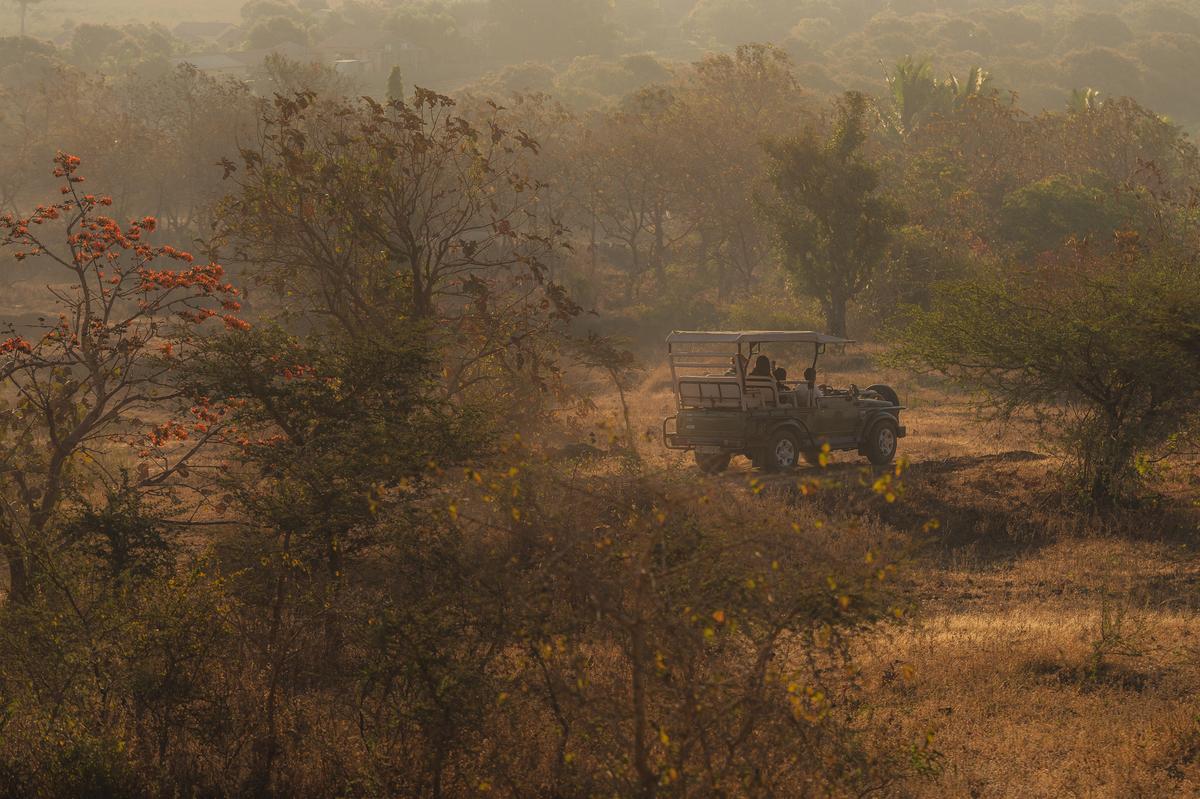
A jeep ventures into the reserve at Gir
| Photo Credit:
Special Arrangement
Woods at Sasan, where we stayed on the park’s edge, sits inside an eight-acre mango orchard just outside the forest boundary. Conceived as the flagship property of 1000 Island Hotels & Resorts by Maulik Bhagat and architect Maria Portella, the retreat spreads across low stone structures positioned carefully between the trees. Thirty-eight private stays sit apart from each other, allowing the orchard to remain intact. Built largely with local stone, lime plaster, reclaimed wood, khadi, terracotta, and cane, the structures rely on thick walls, intelligent orientation, and natural light. Concrete is used sparingly, plastic has been reduced almost entirely, and not a single mango tree was cut to make way for construction.
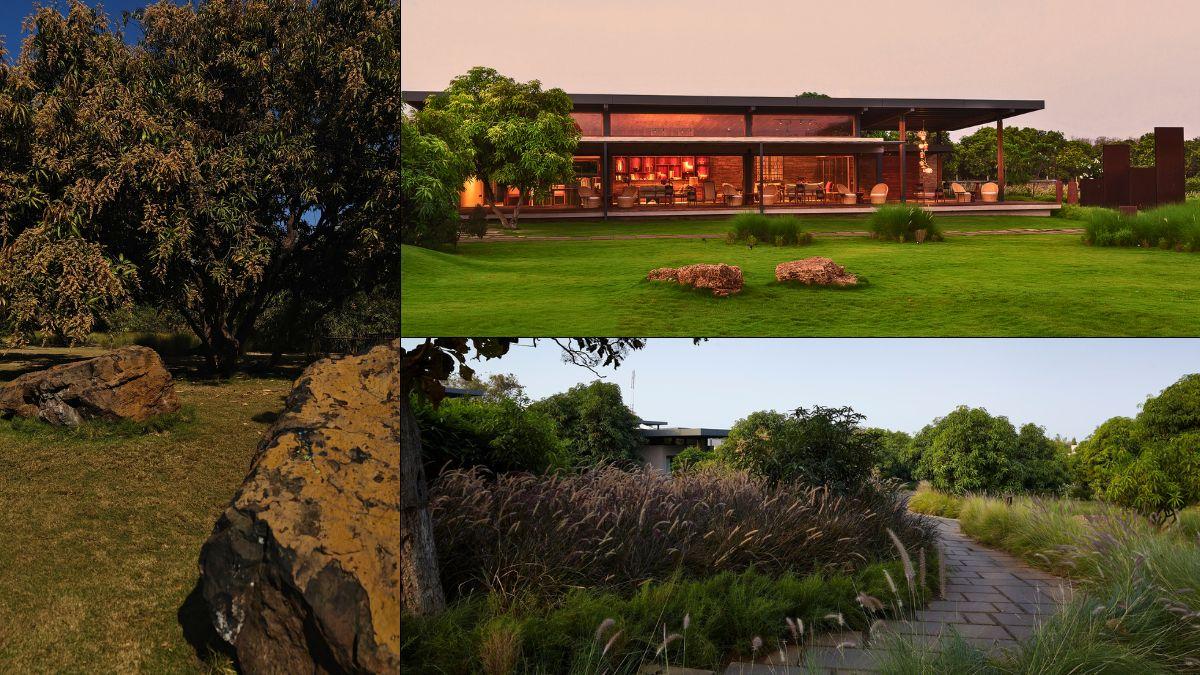
Views from the property at Woods at Sasan, Gir
| Photo Credit:
Ayaan Paul Chowdhury/ Special Arrangement
Laurent Guiraud, the French restaurateur who now oversees operations at Woods, described the retreat’s biophilic philosophy through three pillars: culture, community and well-being. Much of the staff come from nearby villages, and dozens of local artisans worked on the construction. “We want to bring more than we take into the ecosystem,” he said. Well-being at Woods, he explains, forms a connective tissue that emphasises sleep, silence, darkness, the preservation of ancient natural rhythms and respect for the nocturnal lives that begin where the orchard ends.
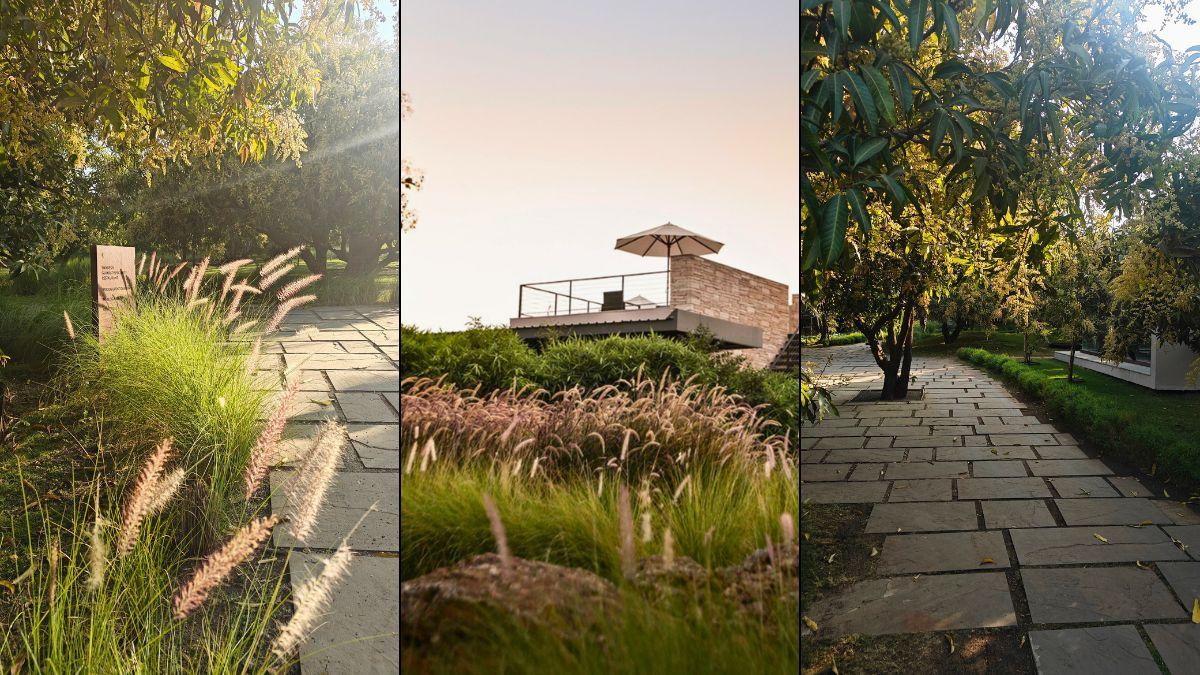
The pathways around the mango orchard at Woods at Sasan, Gir
| Photo Credit:
Ayaan Paul Chowdhury/ Special Arrangement
Those rhythms made themselves felt on my very first night. In winter, Delhi rarely allows you to see the moon let alone any other celestial offerings through its particulate soup. But here, I found myself standing beneath the clearest night sky I had seen in years, the orchard opening up above us as constellations sharpened into view one after another, as if someone had turned the contrast knob all the way up. Beneath that sky, the culinary team at Woods prepared a barbecue in the orchard, smoke curling into the cold air while Laurent serenaded us with stories from his early years in India. He spoke about arriving in Delhi as a young “gora” professional, navigating the capital’s restaurants and generously inflated alcohol tolerances that could humble a visiting Frenchman. He admitted that his move toward Gir felt like an inevitable gravitation away from noise toward something calmer and more elemental.

Our mornings at Woods began before dusk. On our first day, Akash Ahir — the property’s naturalist and an endlessly enthusiastic interpreter of Gir’s ecology — led us on a hike through the forest that wrapped around the orchard. The land here is often frequented by lions in the early hours, a fact Akash mentioned with cheerful nonchalance as we stepped over fresh pugmarks pressed into the dust. Eventually, the trail opened into a clearing atop a low rise, where breakfast appeared with improbable timing, and we sat watching the sun lift over a mosaic of forest tracts dissolving into agricultural plots at the horizon. The afternoon drifted past with a Gujarati thali at Swadesh, frequent stops at the retreat’s charming wellness centre, and long conversations about cinema and food before sleep.
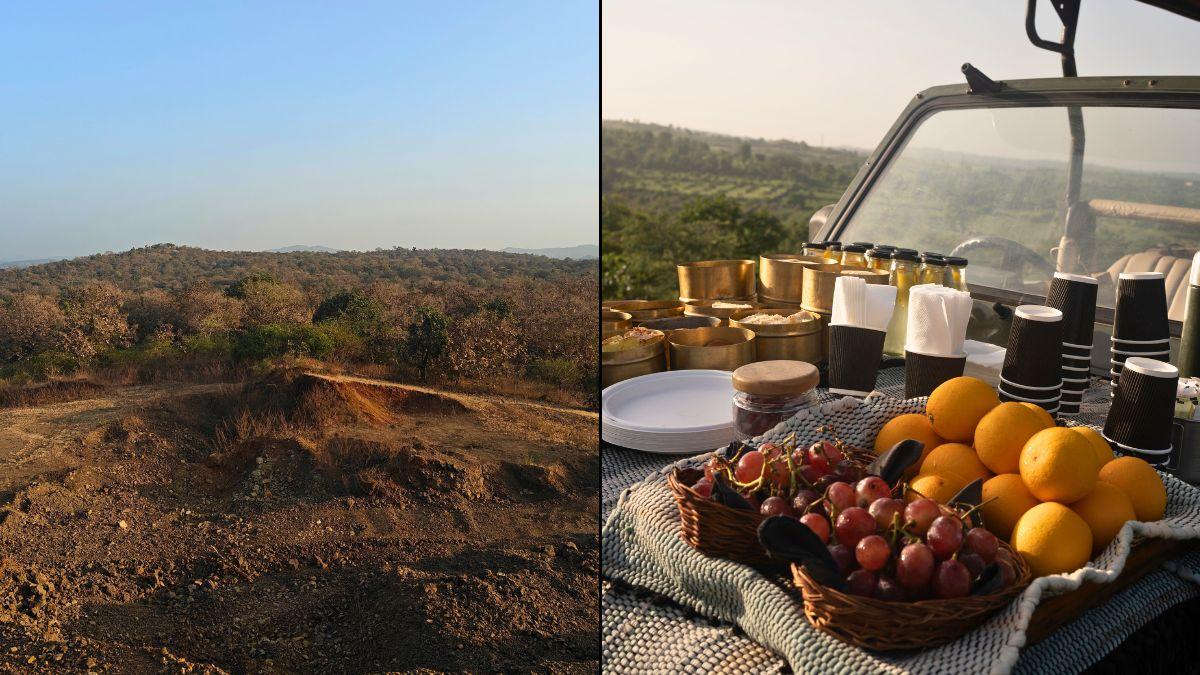
Hilltop breakfast after a morning hike
| Photo Credit:
Special Arrangement
The rest of our time there slipped into a pleasant wooze. Lunch was a fantastic traditional Gujarati thali at Swadesh, the property’s signature restaurant. Between meals, we drifted in and out of SOM, the retreat’s wellness space, which offered a range of therapies rooted in designed as recalibrations for the body to catch up with the environment. Later, pizzas for supper from a wood-fired grill, followed by long conversations with Laurent about French New Wave cinema and culinary memories in Paris.
On safari day, we were up again before dawn, layered against the cold, climbing into an open jeep headed for the Gir National Park Centre. Dozens of tourists gathered in jittery clusters, with guides barking instructions into the chilly air. A giant bronze lion presided over the plaza as State-authorised jeeps rolled out one by one. Everyone I had spoken to before this trip seemed suspiciously confident about sightings. Several of them claimed that the probability of spotting a lion here bordered on inevitability, and that I would have to possess spectacularly rotten luck to leave the forest without seeing one. Sitting there wrapped in a blanket burrito while the jeep was swallowed by the darkness, that confidence began to waver.
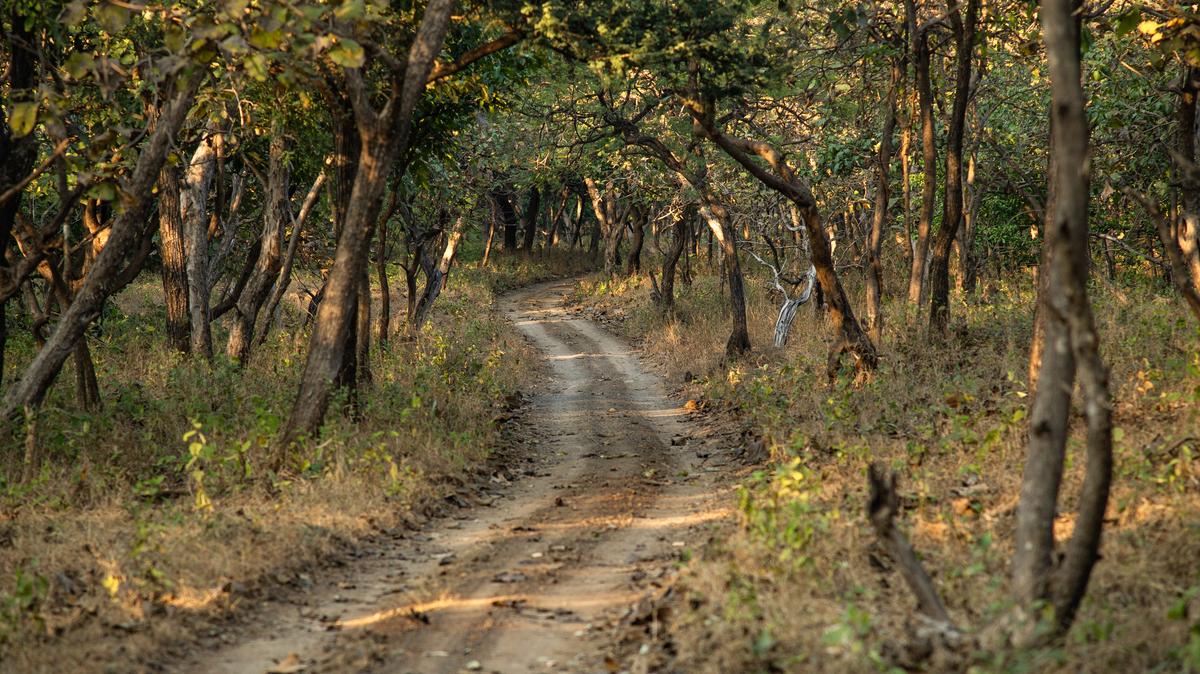
A safari path at Gir
| Photo Credit:
Special Arrangement
The forest at that hour felt immense and inscrutable. Our headlights cut a narrow corridor through the darkness while the canopy thickened overhead and the dry leaves beneath the tires cracked loudly enough to make me wince, as if we were announcing our presence to every creature within a kilometre. My thoughts drifted, somewhat unhelpfully, toward the kitschy but deeply entertaining 1996 thriller The Ghost and the Darkness, where Val Kilmer and Michael Douglas spend two hours being terrorised by a pair of legendary man-eating lions in colonial East Africa. Naturally, as the jeep rattled along the track I began to notice every faint rustle in the brush and every pair of reflective eyes flashing momentarily from the darkness before vanishing again.

Barely twenty minutes into the drive, our driver braked. Ahead of us, stretched languidly across the path as if the road belonged to them, lay three lions. One was a semi-adult male, his mane still developing into a modest ruff, and beside him lounged two adult females whose bodies carried the heavy, satisfied slackness of having clearly eaten their fill. The three of them blinked slowly in the weak glow of our headlights, offering us mild acknowledgment, before returning to the very urgent business of their early morning siesta.
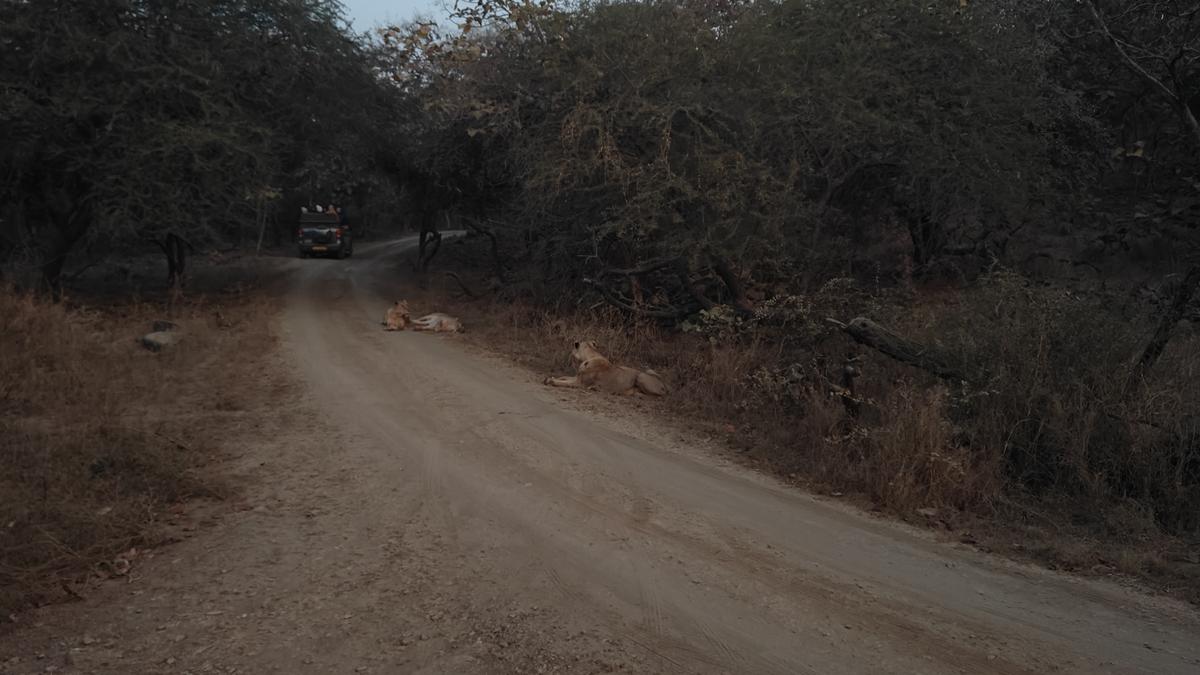
Three lions rest at dusk at Gir
| Photo Credit:
Ayaan Paul Chowdhury
As dawn seeped into the forest, the landscape revealed itself in layers. Spotted deer appeared first, their white markings faintly aglow as they froze mid-step to watch us pass. The terrain kept shifting. Dry deciduous stretches opened into grasslands where the horizon briefly widened, then folded back into thorny acacia and rocky outcrops.
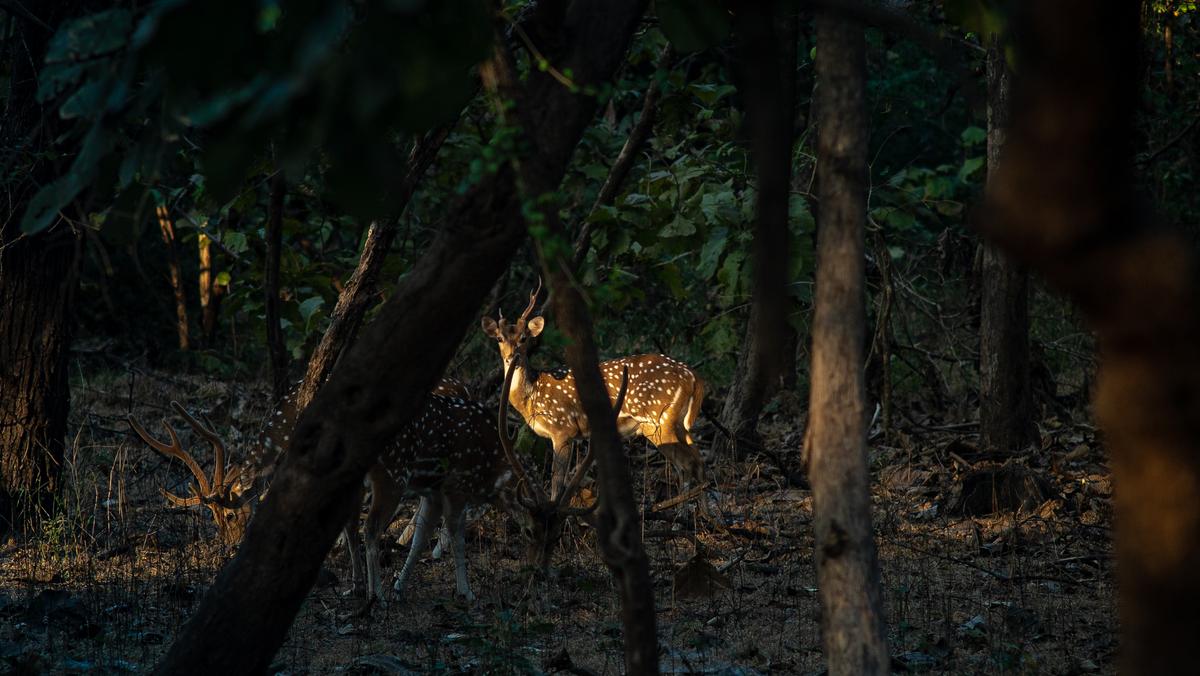
Spotted deer spotted at Gir
| Photo Credit:
Special Arrangement
Three lions within the first 20 minutes felt improbably generous, and lent weight to the satisfaction settling over the jeep as the cold began to lift. About 45 minutes later, a far more immediate concern took hold. Early morning tea, the cold, and the open jeep had converged into a rapidly escalating bladder crisis. I weighed three options: endure it, discreetly soil myself, or risk the most scenic but potentially fatal bathroom break of my life.
Thankfully, the forest had mercy. We reached the designated clearing where vehicles had gathered, an open patch with a restroom. When I returned, Akash was mid-conversation, catching a rumour of something special ahead, so we set off at once. Roughly an hour later, we approached a clearing where a shallow watering hole lay nestled between thick bushes and scattered trees. Around 10 jeeps had already positioned themselves in a semicircle. One by one they gave up and left until we were the only one remaining. “Safari is a waiting game,” Akash said calmly. “The people who wait the longest usually win.” That patience soon paid off.
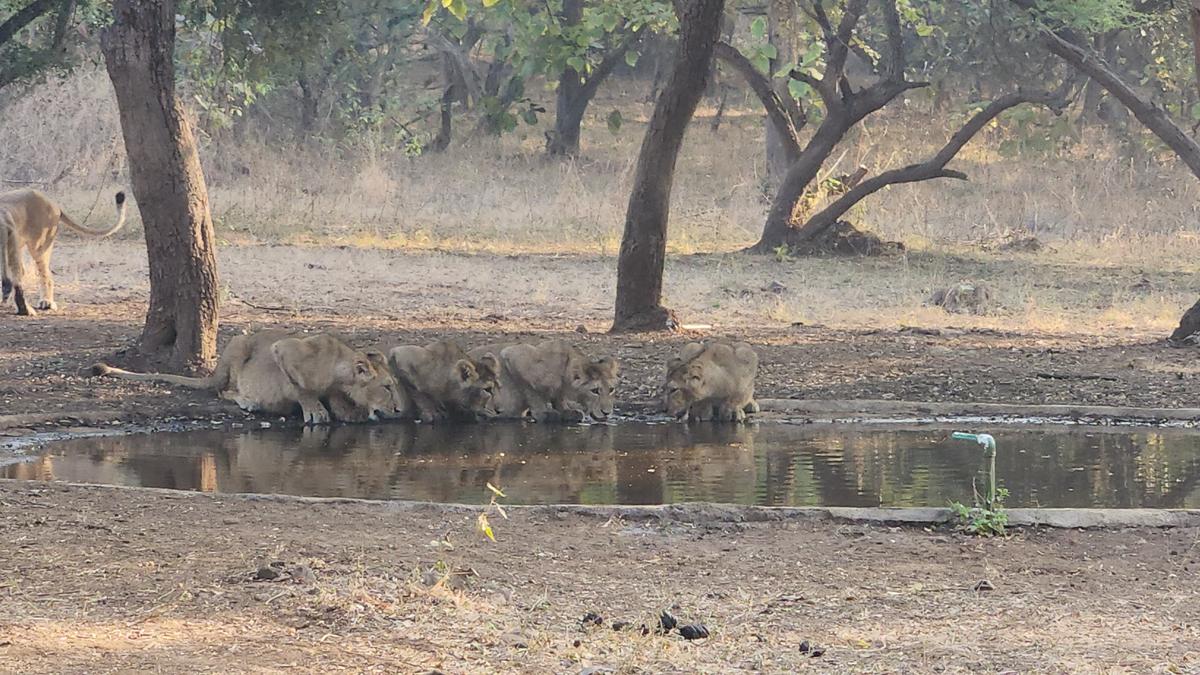
A pride of lions spotted at Gir
| Photo Credit:
Ayaan Paul Chowdhury
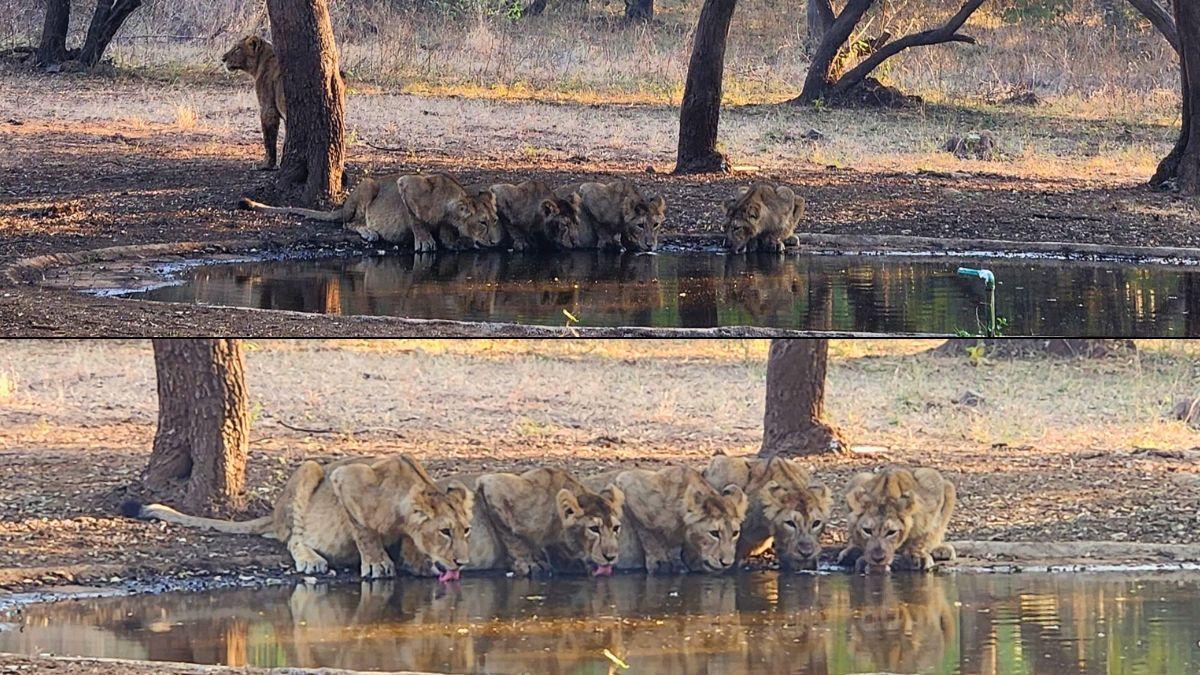
One lion. Then another. Then another, until eight lions had assembled around the edge of the water — six teenage cubs and two adult females standing watch behind them — as they bent their heads and began lapping the surface in slow, rhythmic motions that produced a gentle schlup-schlup against the stillness of the clearing.
The cubs jostled each other playfully, biting at tails and nudging shoulders while the adults kept a vigilant eye on the surrounding forest. Not once did they acknowledge the jeep full of stunned humans sitting barely 10 metres away. After several long minutes they finished drinking, stretched lazily, and one by one slipped back into the bush from which they had emerged.
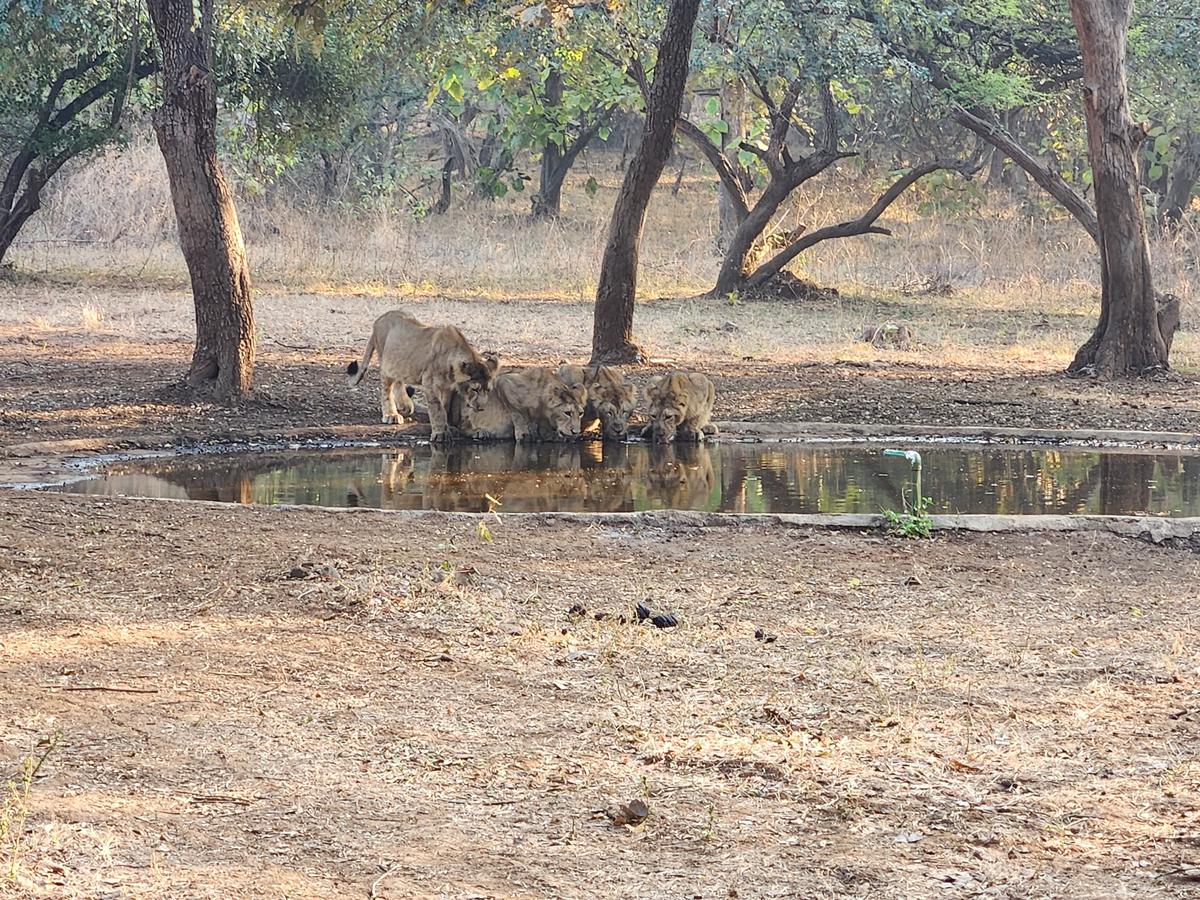
A pride of lions spotted at Gir
| Photo Credit:
Ayaan Paul Chowdhury
Later Akash would tell us that sightings like that were rare. He told us the pride descended from two once-dominant male lions named Jai and Veeru, after the characters in Sholay. The two had ruled their territory together for years before being killed in battle by rival lions, leaving their cubs vulnerable to being purged of their heredity. What saved them was the tactical intelligence of the adult females, who shepherded the cubs in a cautious migration designed to keep them beyond the reach of the new alphas. When chance encounters with those ethnic cleansers became unavoidable, the lionesses resorted to what zoologists politely describe as “false mating behaviour,” which is scientific shorthand for honeytrapping the enemy long enough for the children to escape.
Turns out a few days in Gir and a chance encounter with some unexpectedly empowered resident feminist icons is sometimes all it takes to rethink a few earlier convictions. But if the morning also throws in eleven of the country’s most photogenic apex predators, well that’s hardly something to complain about.
This writer was in Gir at the invite of Woods at Sasan