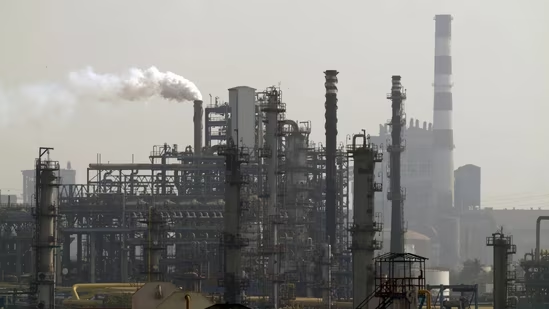
Big oil shocks, a generation of economists has been taught, are a relic of the distant past, when energy production was concentrated in the Middle East and the world economy was not so energy-efficient. Over the past two weeks, however, the old way of thinking has returned from the scrapheap. A big enough shock in the Gulf, it turns out, can still initiate a profound crisis. And the shock emanating now from the Strait of Hormuz is huge.

Iranian missiles have trapped about 15% of global oil supplies on the far side of the strait. That is roughly twice the disruption the world suffered in the 1970s, offsetting the fact that the energy-intensity of the world economy has fallen by half since then. Although the International Energy Agency (iea) announced on March 11th the release of up to 400m barrels from emergency reserves, that is only a temporary fix, subject to bottlenecks of its own. Prices rose after the announcement.
Read all our coverage of the war in the Middle East
About a fifth of the world’s shipments of liquefied natural gas (LNG) have been halted, too, and the shock is spreading to other commodities. The price of fertiliser, which is made using natural gas, is surging, stoking fears of food shortages. Sulphur, a by-product of oil-refining, is getting more expensive as well, which will in turn affect copper-smelting. A dearth of helium is imperilling production of computer chips. The IMF has urged governments to prepare for the “unthinkable”.
No way out
In light of the effective closure of the strait, and the lack of an assured means to reopen it, price movements have, if anything, been modest. Crude oil was only about $25 a barrel above pre-war levels as The Economist went to press, having fallen back after Donald Trump said on March 9th that his “little excursion” in Iran was already “very complete, pretty much”.
But every day that passes without America’s president making good on that pledge, it becomes harder for the market to balance supply and demand. Nobody knows what price would be necessary to shave 15% off the world’s appetite for oil permanently. If the Strait of Hormuz remains closed just until the end of the month, some analysts reckon crude could surge to $150 or even $200 a barrel. That would be a recipe for global recession and a surge in inflation—a repeat of the “stagflation” of the 1970s. Even in a middling scenario, in which some oil trickles through the strait but most shipping remains disrupted, the damage to the world economy would be severe.
Severe, but uneven. Look at America’s financial markets and you would not conclude economic Armageddon was nigh. The S&P 500 index of stocks is down by a modest 1.5% in March. The yield on ten-year Treasury bonds has risen, but not yet exceeded its high over the past three months. Look at Europe and things seem a little worse: European stocks are down 5-6% on the month. In Asia things look even more troubling: Japanese stocks are off 7.3%; South Korean ones by over 10%.
In other words, financial markets are expecting some regions to suffer more than others. Since 2019 America has been a net energy exporter, owing to its fracking boom, meaning that parts of its economy benefit from higher oil prices. Its economy is also far less oil-intensive than it once was. Since the 1970s the ratio of oil consumption to real GDP has fallen by more than 70%, as vehicles have become more efficient and cheap natural gas has replaced oil in heating and power generation. Although America’s exports of LNG have grown in recent years, they have not done so to the degree that would be necessary to equalise gas prices with Europe, where they are now more than five times as high.
Still, American consumers are already feeling the pain at the petrol pump, where low tax rates mean prices are especially sensitive to movements in the oil market. A rule of thumb holds that every $10 rise in oil adds roughly 25 cents to the price of a gallon of gasoline. Average pump prices have climbed by nearly 20% since the war began, a number that will rise more the longer the war goes on. And if consumers spend less on other goods as a result, the economy will suffer a hit to local demand, even as its oilmen rake in higher profits.
That would not be something that the Federal Reserve, grappling with above-target inflation even before the war, will be in a position to offset easily with lower interest rates. Traders still foresee rate cuts, but fewer than they did before the war: their expectation of where rates will be a year from now has risen by 0.4 percentage points since the end of February, to about 3.3%. This is putting upward pressure on Treasury yields, which might otherwise be expected to fall in times of global stress.
More at risk of an inflationary shock is Europe. To wean itself off Russian gas delivered by pipeline, it has come to rely heavily on LNG. The iea recently projected that it would need to import a quarter of global shipments of the stuff. That leaves Europe exposed to soaring LNG prices.
A bidding war for LNG has ignited on the spot market, with shipments redirected in response to higher offers. Clean Mistral, a tanker, had been sailing to Spain from America when it abruptly turned and headed for Asia instead. Europe’s benchmark gas price climbed above €56 ($65) a megawatt-hour on March 9th, more than 75% higher than before the war began, though it has since eased slightly.
For now, a repeat of the energy shock that followed Russia’s invasion of Ukraine in 2022—when gas prices briefly topped €300 a megawatt-hour, inflation in the euro area rose above 11% and the continent’s economy stagnated for more than a year—looks unlikely. Nonetheless, higher gas prices will still feed into inflation—especially in Britain, where gas still fuels almost 30% of power generation (see chart 1). Central bankers often try to ignore energy shocks, since they should cause just a passing jump in inflation. But that works only if ordinary people expect inflation to subside again—a questionable assumption after several years of inflation above central banks’ targets of 2%.
Goldman Sachs, a bank, estimates that after periods of high inflation a 10% increase in energy prices raises long-run inflation expectations in the EU by around 0.12 percentage points, roughly three times the normal effect. If disruptions in the Strait of Hormuz persist for five more weeks, the bank reckons euro-area inflation could rise by nearly a percentage point over the next year.
Indeed, before the war traders had been betting that the ECB would soon begin cutting interest rates. Now they expect the opposite. Markets are predicting two quarter-point rate increases by the end of the year as investors reassess the inflation outlook. The central bank could find itself unable to succour the economy just as the squeeze on consumers and companies from rising energy prices starts to hurt. If it raises rates, it could even intensify the pain.
Asian economies are more exposed still. The region depends far more heavily on imported energy. The Gulf supplies between 40% and 80% of seaborne crude bought by China, India, Japan and South Korea, along with a large share of their gas. In 2025 Asia absorbed roughly 87% of the crude and 86% of the LNG passing through the Strait of Hormuz.
Although China imports more than 11m barrels of crude a day, government and commercial stockpiles cover more than 100 days of imports. LNG storage should last over 40 days. Officials have already begun bolstering domestic supply, ordering refiners to suspend exports of diesel and petrol. China’s controls on fuel prices shield consumers from higher crude costs; much of the burden will fall on state-owned refiners rather than households.
East of Hormuz
The rest of Asia, though, will not be so lucky. Imports account for 87% of Japan’s energy consumption and 84% of South Korea’s, according to the iea. Both also rely heavily on oil from the Gulf. Japan gets about 95% of its oil from the Middle East, with roughly 70% routed through the Strait of Hormuz. South Korea buys about 70% of its oil and around a fifth of its LNG from the region. Strategic reserves offer some cushion, but a lasting rise in prices would sharply inflate import bills.
Higher energy costs are weighing on currencies that were drooping to begin with. On March 9th the South Korean won briefly approached 1,500 per dollar, its weakest level since 2009. The slide in South Korea’s equity markets has been severe enough to rattle politicians. Lee Jae-myung, the president, is so alarmed he has announced a 100trn won ($68bn) scheme to stabilise the stockmarket and has promised to cap fuel prices.
Companies and consumers in the rich world are likely to prevail in bidding wars for scarce commodities; their governments, though increasingly indebted, can afford to provide handouts. It is poorer Asian countries that are likely to bear the brunt of the energy shock, bringing strain on both the public finances and the external balance of payments.
India spends roughly 3% of GDP a year on imported oil and Thailand nearly 5% (see chart 2). When prices rise, bills swell quickly. Goldman Sachs reckons that a lasting jump from $70 a barrel to $85 would sap Thailand’s current-account balance by about 1.2% of GDP and India’s by roughly 0.6%—and the current price is higher. Wider deficits tend to weaken currencies. India’s rupee recently fell to a record low against the dollar, raising the cost of imports and so amplifying the economic pain.
Another risk lies in remittances. Millions of Bangladeshi, Indian and Pakistani workers in the Gulf send money home. Damage to Gulf economies will reduce those inflows and so harm those countries’ balance of payments. To make matters worse, on March 10th the United Nations warned that food prices could rise too, on account of higher energy, fertiliser and transport costs.
Public finances will also take a hit. Many governments suppress retail fuel prices through subsidies, tax cuts or self-denial at state-owned oil firms. This cushions households from oil shocks but shifts the burden onto the state. India, for instance, was already spending more than $30bn a year subsidising retail energy. The poorest economies may have little choice but to accept shortages and rationing. Many simply cannot afford soaring LNG prices. Fertiliser plants are shutting across South-East Asia. The Philippines has ordered government offices to switch off computers at lunch and cut back on air-conditioning; Bangladesh has brought forward the Eid holiday. In the most distressed cases, governments with fragile finances, such as Pakistan’s, which relies on IMF lending, may find themselves unable to pay swelling bills for imports.
Most Gulf countries are unlikely to be brought to the brink of crisis, given that many of them have huge stashes of petrodollars tucked away. But they could well suffer the deepest recessions, and the most fundamental shock to their economic models. Iran has struck oilfields, refineries, ports and airports across the region—the infrastructure that underpins their prosperity. Although a Saudi pipeline can reroute some oil to Yanbu, a port on the Red Sea, most oil produced in the region is now trapped there.
Going without the flow
Overflowing storage is forcing oil companies to suspend production—and thus forgo billions of dollars of revenue a week. If the strait remains closed until April and production takes two months to recover, annual hydrocarbon output could fall by roughly 12-16% in Saudi Arabia and the UAE, Goldman Sachs estimates. Losses in Bahrain, Kuwait and Qatar could exceed a quarter of annual production.
Oil is not the only industry under strain. The Gulf has also become a big exporter of metals and chemicals, but the conflict is forcing those plants to close, too. A big Qatari aluminium smelter has suspended production. An even bigger one in Bahrain has halted exports.
Tourism has also been hammered. In Bahrain and the UAE the industry accounts for more than 12% of GDP—above the global average. Missile strikes not only halt those flows in the short term; they also dent them long after the fighting stops. Excise and value-added tax receipts—increasingly important sources of government revenue—atrophy along with visitor numbers. Property markets dependent on foreign buyers may also slide.
All told, a two-month conflict could cause GDP to contract by double digits in Bahrain, Kuwait and Qatar, with declines of roughly 8% in the UAE and about 5% in Saudi Arabia, according to Goldman Sachs. Worse, the conflict threatens the region’s economic model. For years its monarchies have marketed themselves as safe, stable hubs for capital and talent. That image is now tainted.
Mr Trump may believe he can limit the war’s economic damage by reining in the fighting if markets panic. But much harm has already been done. And unlike in the trade wars he has initiated, he does not control all the levers. “We are the ones who will determine the end of the war,” growled a spokesman for Iran’s Revolutionary Guards this week.