

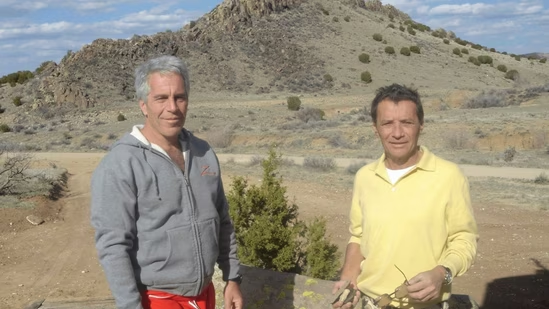
Jean-Luc Brunel was ready to turn on the man who had been his patron and partner. The French modeling scout was prepared to tell prosecutors what he knew about Jeffrey Epstein’s sex trafficking.


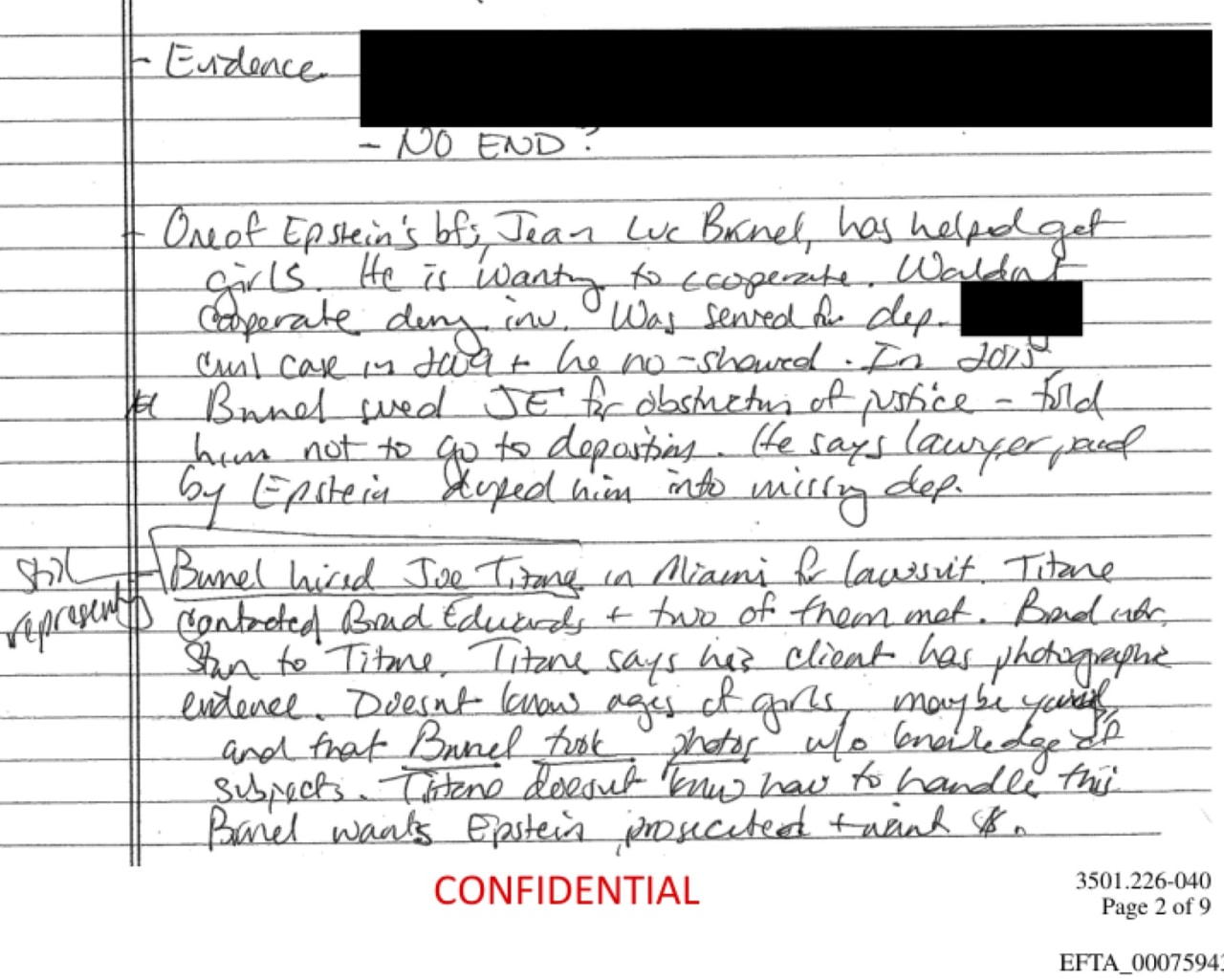
Brunel was secretly negotiating in 2016 with lawyers representing Epstein’s victims, according to newly released Justice Department files. Brunel’s lawyer told them his client recruited girls for Epstein and had incriminating photographs. They discussed a date for Brunel to walk into the U.S. Attorney’s office in New York—in exchange for immunity.
“One of Epstein’s bfs, Jean Luc Brunel, has helped get girls. He is wanting to cooperate,” according to handwritten notes taken by a federal prosecutor in February 2016. “Brunel is afraid of being prosecuted.”
And then Brunel went dark.

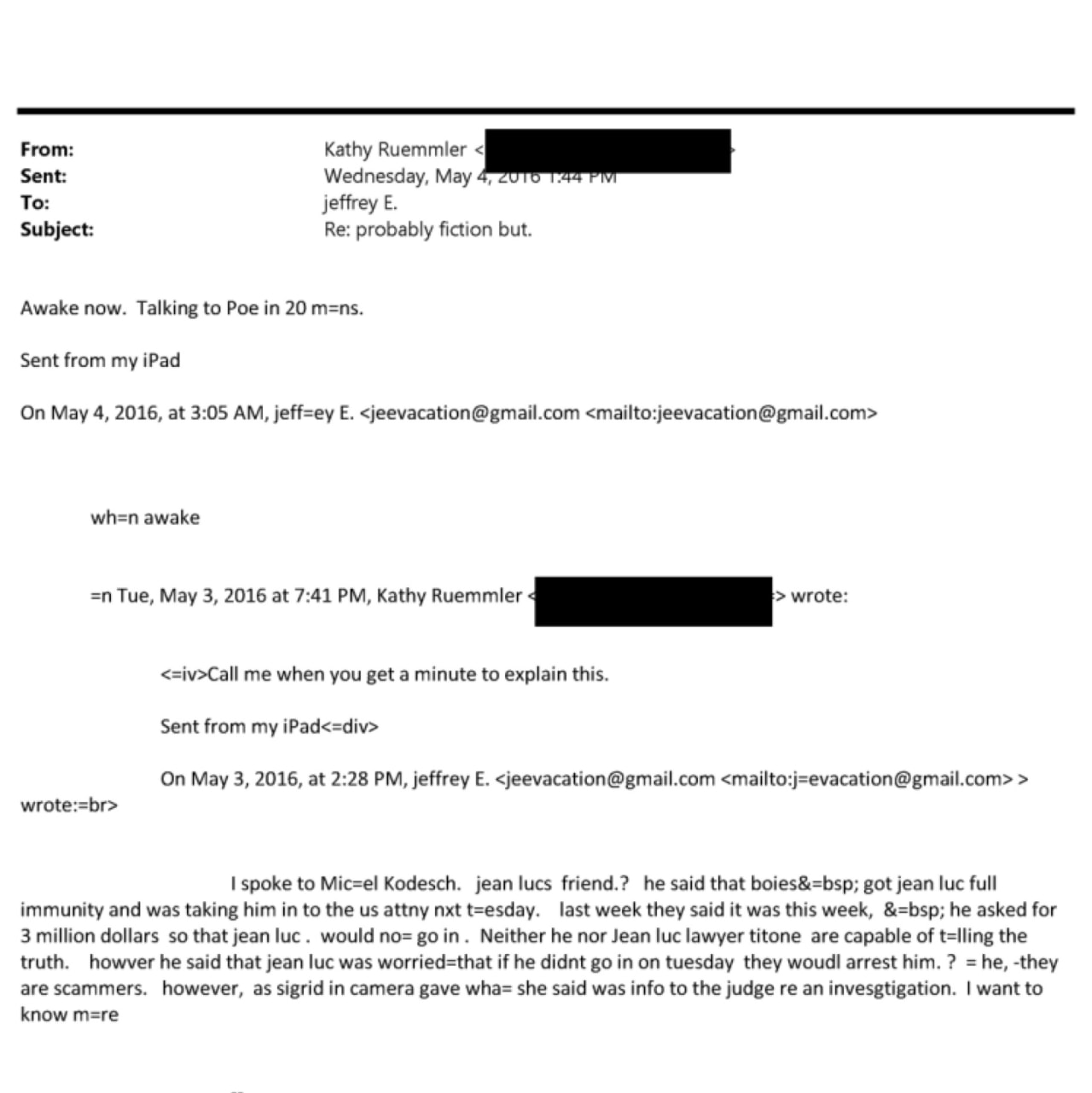
Epstein had discovered that negotiations with Brunel were taking place, the files show. On May 3, he fired off an email to Kathy Ruemmler, an attorney he corresponded with regularly. He wrote that Brunel was planning to go to the U.S. Attorney’s office the following week and one of Brunel’s friends had “asked for 3 million dollars so that Jean Luc would not go in.”
Epstein told Ruemmler that Brunel was afraid he would be arrested if he didn’t show up. “I want to know more,” Epstein wrote. He also dismissed Brunel’s lawyer and his friend as “scammers” and cast doubt on their credibility.
Ruemmler responded hours later, asking Epstein to call and explain. The next day, she wrote: “Awake now. Talking to Poe in 20 mins.” Gregory Poe was Epstein’s lawyer in Washington, D.C.

It isn’t clear from the documents why Brunel ultimately kept quiet. What is clear is that Brunel didn’t cooperate with prosecutors and Epstein remained free for another three years, until he was arrested in 2019. He died in jail in New York in what was ruled a suicide by the city’s medical examiner.
After Brunel stopped negotiations, he wasn’t arrested and prosecutors didn’t pursue him further.
“It set us back a couple of years,” said David Boies, one of the attorneys who filed civil lawsuits on behalf of Epstein victims, referring to Brunel’s backing out. “We know from our lawsuits that there were more than 50 girls that were trafficked after this.”
Brunel was a central figure in Epstein’s orbit who used his position atop a U.S. modeling agency to recruit foreign girls and young women, securing work visas and providing the appearance of real employment. The Frenchman traveled on Epstein’s plane, visited his island and exchanged hundreds of emails with him.
The files also show that federal prosecutors in New York were briefed on Epstein’s scheme in 2016. The handwritten notes detailed Epstein’s trafficking operation and allegations that Brunel, Ghislaine Maxwell and others recruited dozens of underage girls.
The Justice Department didn’t move on Epstein until after a Miami Herald investigation in late 2018 brought new attention to Epstein’s case. When they did arrest Epstein in 2019, Brunel and Maxwell were named as co-conspirators in the FBI investigative file, the documents show.
The prosecutor who took the February 2016 notes later told Justice Department officials that she discussed the meeting with colleagues in the U.S. Attorney’s office and the FBI but that no investigation was opened, according to a 2021 government court filing. The notes about Brunel were redacted in the 2021 court filing. A spokesman for the U.S. Attorney’s office in New York declined to comment.
Joseph Titone, Brunel’s attorney, told The Wall Street Journal he advised Brunel to cooperate and cut ties with Epstein. “I recommended and advised him to stop communicating with Epstein, but he never did,” Titone said.
Brunel was arrested in 2020 in France, where French prosecutors were investigating him on allegations of rape and supplying girls to Epstein. He died in jail in 2022. Maxwell was found guilty in 2021 and is serving a 20-year sentence.
Prosecutors in Paris on Saturday said they would re-examine the case of Brunel and set up a special team to analyze evidence that could implicate French nationals in the Epstein case.
“This was another instance of Epstein attempting to engage Ms. Ruemmler on a matter about which she had no knowledge, and she appropriately directed him to his legal counsel,” said Jennifer Connelly, a spokeswoman for Ruemmler. She declined to specify which legal counsel. Ruemmler has said she never represented Epstein and regretted her association with him.
As the extent of her relationship with Epstein became clear in the recent files, Ruemmler said last week she would resign from Goldman Sachs, where she is general counsel, in June.
Poe said he didn’t talk with Ruemmler or Epstein about Brunel “on May 4, 2016 or at any other time.” He said he had a scheduled call that day with Ruemmler to discuss his work on a legal motion to quash a subpoena directed at Epstein. “My engagement by Jeffrey Epstein was limited,” Poe said, adding that he terminated work for Epstein in August 2016.
‘put her on your payroll’
Long before his role in the Epstein case came to light, Brunel already had a sordid reputation in the fashion world. In 1988, CBS’s “60 Minutes” aired an investigation into modeling agencies featuring women who said they were drugged by Brunel and expected to have sex with his male friends in order to get modeling work.
One woman said on camera that Brunel had drugged and raped her. No criminal charges were ever filed, and Brunel, who denied the allegations, continued to operate freely, cycling through agencies.
By the 2000s, Brunel and Epstein had forged a deep relationship. Flight logs show Brunel was a frequent passenger on Epstein’s private jet starting around 2000.

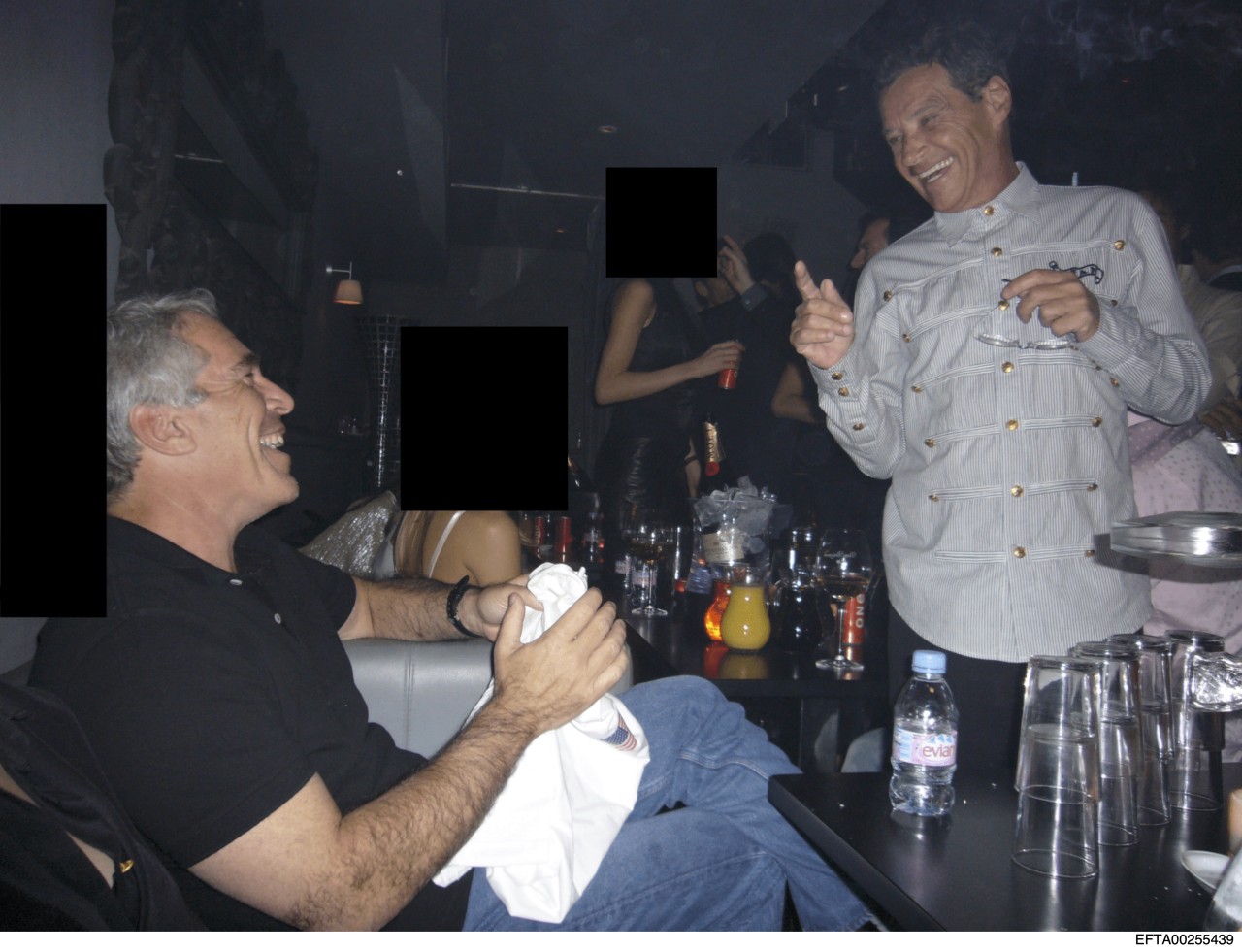
In 2005, Epstein wired up to $1 million to Brunel to help him launch MC2 Model Management, which opened offices in New York and Miami later that year. The agency’s name appeared to be an inside joke, with people believing that in the equation E=MC², the E stood for Epstein.
Behind the scenes, Epstein used the agency as a way to procure women and as a payroll vehicle, securing work visas for young women, the files show.
A pair of emails from July 2006 captures the arrangement. On July 13, Epstein wrote to Brunel at his MC2 address, instructing him to put a woman they were discussing “on your payroll,” specifying a $50,000 annual salary.
Brunel asked whether Epstein wanted the woman to work scouting models. Epstein replied the next day: “Start salary as soon as possible.” Epstein added that he would be in Paris the following week and “could see her then.”
When Epstein was jailed in Florida in 2008 after pleading guilty to procuring a minor for prostitution, Brunel visited Epstein almost 70 times, according to jail logs.
‘Talk to me first please’
After his Florida arrest in 2006, Epstein shifted his focus to women in their late teens and 20s from Europe and Russia, whom he could lure to the U.S. and abuse, since they were dependent on him for visas, housing and finances. He also pressured these women to share with him details about their interactions with other men.
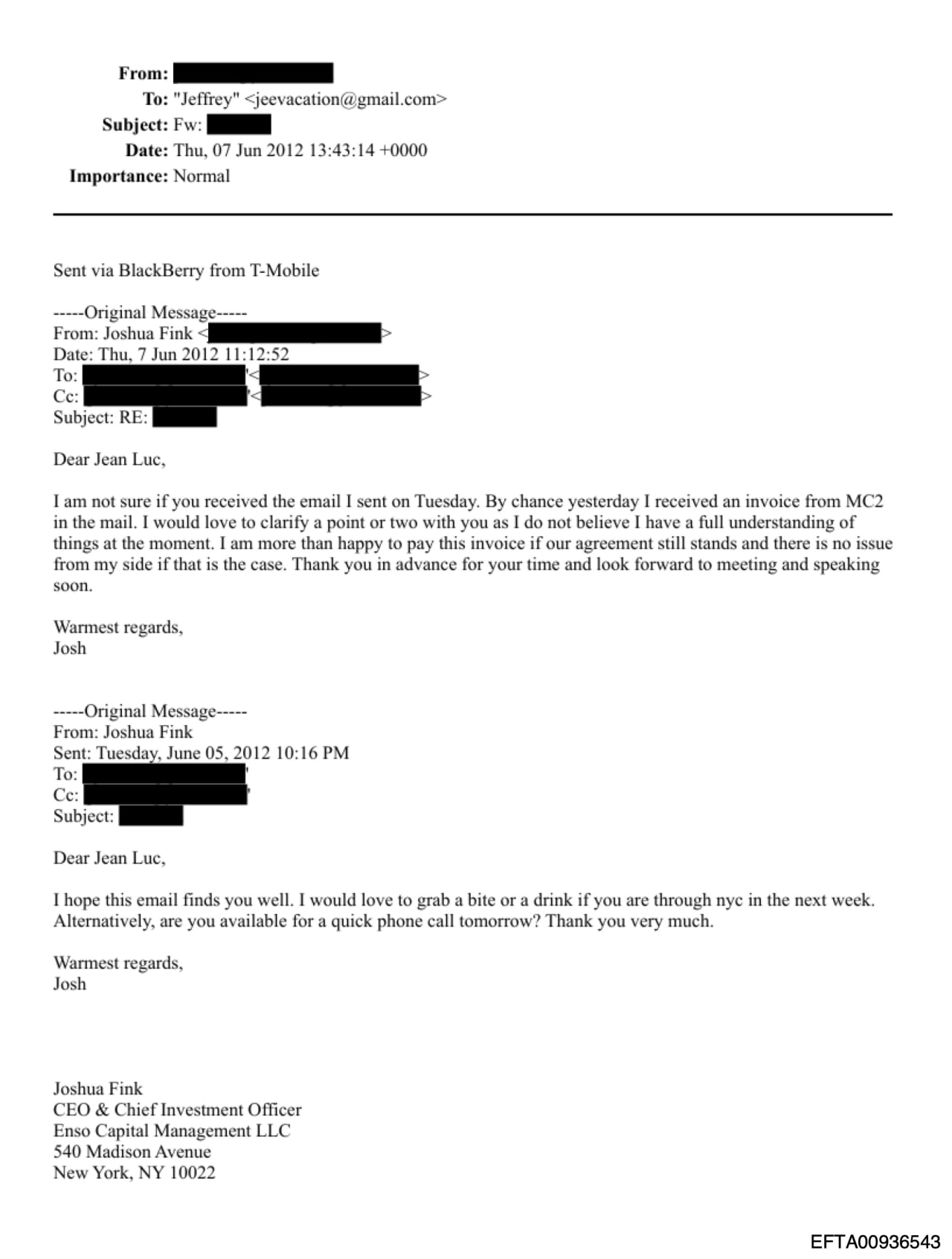
By 2012, Brunel was in frequent communication with Epstein. On June 7 of that year, Joshua Fink, the son of BlackRock CEO Larry Fink, emailed Brunel about an MC2 invoice, saying he had received a bill and wanted to “clarify a point or two” about their agreement. Brunel told Fink he would suspend the billing.
The invoice was related to a model whom Fink was dating that had a work visa through the agency. When Brunel forwarded the email chain to Epstein, the reply was: “Talk to me first please.” When the woman forwarded the same email that day, Epstein replied: “This for past . Not future.”
Epstein was well aware of the relationship. The woman had forwarded him several chat logs with Fink, which captured the couple clashing over how serious their relationship was and whether marriage was on the table.

“And with your visa, I have no idea what it is I can do beyond pay your agency to supplent (sic) your income and theirs because you are not getting work as a model,” Fink wrote in reply to her complaints that he wasn’t doing enough to help her.
Fink told the Journal he met the woman at a friend’s dinner party and started a romantic relationship that lasted roughly a year. “I had no relationship with Epstein or Brunel,” he said. “I am totally shocked that she was forwarding electronic correspondence to Epstein.”
He said he was helping the woman settle her debts with the modeling agency and loaned her money to pay off Brunel. “She wasn’t working or getting enough jobs, and so she had suggested at one point, hey, could you help me settle these debts?,” he said. “And so that was the correspondence.”
“It was a personal relationship, and personal things happen,” he added.
The woman described herself to the Journal as trapped in a web of abuse controlled by Epstein and Brunel. She said she had been a successful model abroad with a top agency, but after signing with MC2 and getting a work visa through the agency, her work dried up. She said Brunel charged fees without securing castings and that Epstein abused her throughout.
The woman said she had met Fink on her own, independent of Epstein and Brunel, and saw the relationship, which she said was consensual, as a possible escape.
But Epstein wanted the relationship with Fink to end to keep her under his control, the woman said. When Fink proposed meeting her in Paris to resolve their issues and discuss marriage in late 2012, Epstein blocked it and the relationship ended, according to the woman and messages she showed the Journal.
Brad Edwards, a lawyer who has represented more than 200 Epstein victims, including the woman, said, “Epstein’s wealth and power allowed him to infiltrate industries, perhaps most pervasively the modeling industry. He found in Jean-Luc a like-minded predator with whom he could conspire on a daily basis to recruit and control the lives of countless young women, including Jane Doe.”
‘send me the details of the girls’
Brunel and Epstein were so close in 2012 that a version of Epstein’s trust from that year listed Brunel as a beneficiary for as much as $5 million, according to a copy made public in the recent Justice Department files.
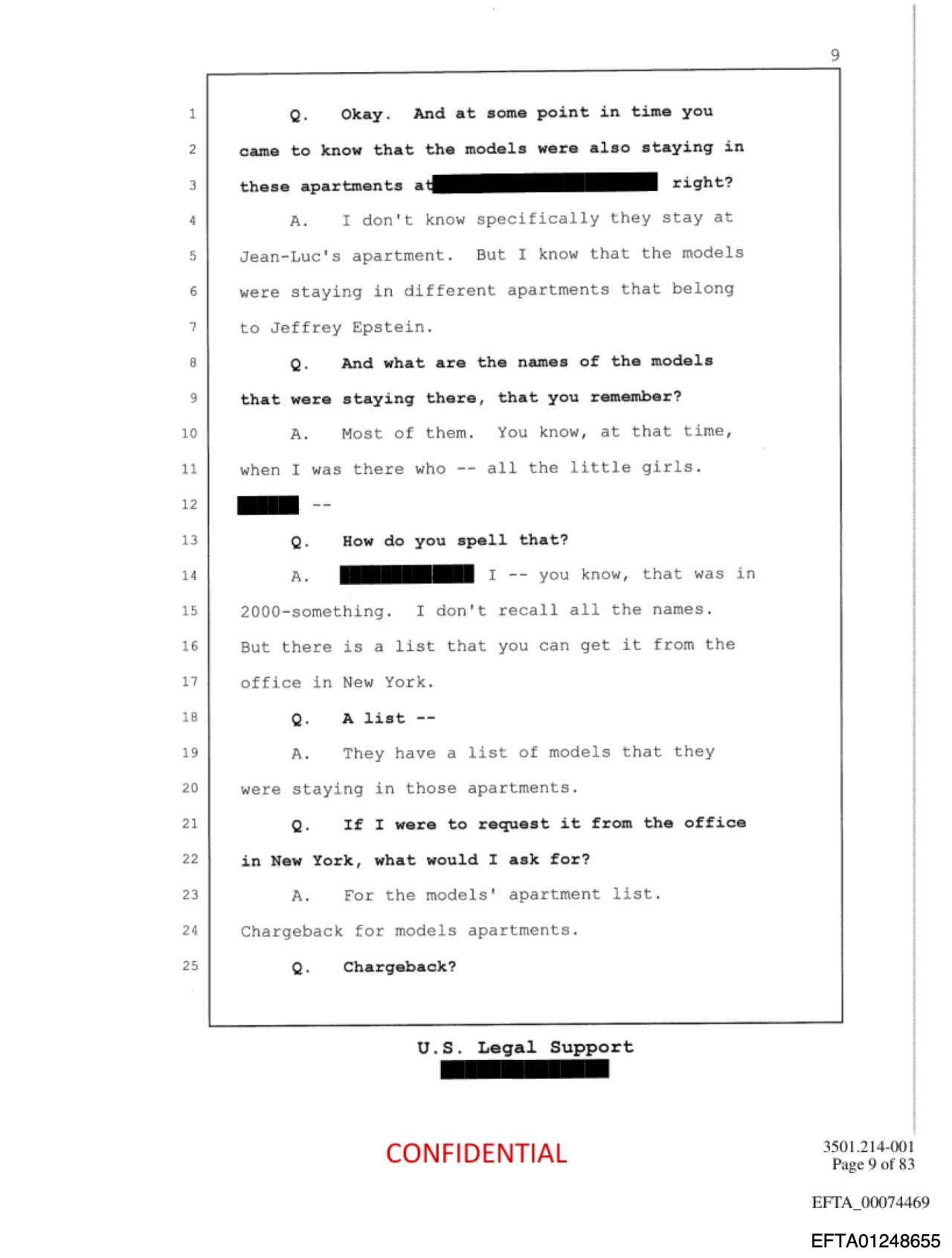
Around that time, Brunel was fretting over a deposition of Maritza Vasquez, MC2’s former financial controller and bookkeeper. Vasquez had given a sworn statement in 2010 in a civil lawsuit filed by one of Epstein’s victims. Vasquez described how models were placed in Epstein-controlled apartments and how visas were arranged for underage girls.
Earlier, Brunel had accused Vasquez of embezzling company funds from 2004 to 2006. She pleaded guilty to a criminal charge in 2007 and agreed to pay restitution of $98,000. Vasquez couldn’t be reached for comment.
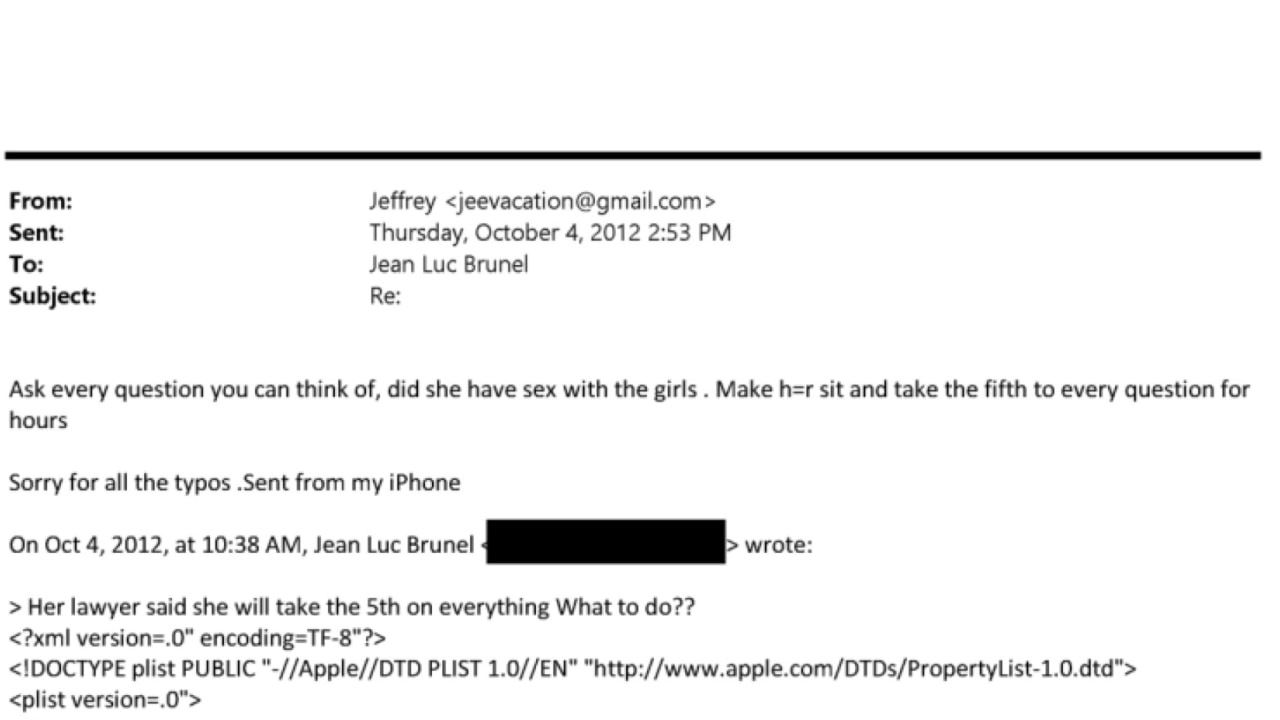
On Oct. 4, 2012, Brunel messaged Epstein: “Her lawyer said she will take the 5th on everything. What to do??” he wrote. Epstein’s reply: “Ask every question you can think of, did she have sex with the girls. Make her sit and take the fifth to every question for hours.”


Brunel and Epstein also relied on a common recruiter, Daniel Siad, to find girls and women in other countries, the files show. Siad, a European modeling scout, exchanged dozens of emails with Brunel and Epstein.
In one exchange from July 2014, Siad informed Epstein that he “had 2 girls from Sweden , a Slovakian ,2 French and [redacted] the Russian ,the with whom you spoke.”
Epstein said he would reimburse Siad for his expenses and said, “please send me the details of the girls names etc.”
Siad compared his recruiting efforts to fishing: “In This busyness I feel like fisherman some time I cache quick , some time no fish.” He ended the message with the tally of his expenses for the trip: 2,700 euros.
Siad’s attorney in France didn’t immediately respond to a request for comment. In a video posted on X and recently broadcast on French TV, Siad said he worked professionally to introduce models to Epstein. “With time, we have learnt that he committed atrocities,” he said.
‘I have some ideas’
In December 2014, Virginia Roberts Giuffre, one of Epstein’s most prominent victims, filed a motion to join a lawsuit that was challenging Epstein’s nonprosecution agreement related to his earlier arrest in Florida. In one of the exhibits, she alleged that Brunel trafficked girls as young as 12 to his friends, including Epstein.
The allegations placed Brunel in public crosshairs alongside Epstein. As a result, the relationship between Brunel and Epstein appeared to fray.
In January 2015, Brunel and MC2 sued Epstein in a Florida court, claiming the agency had gone from being worth millions to “almost worthless” because of the notoriety surrounding Epstein’s crimes. The lawsuit alleged Brunel had lost potentially $10 million in profits, that photographers and scouts had cut ties with MC2, and that Brunel could no longer recruit new models because families refused to entrust their daughters to a man publicly linked to Epstein.
The following month, Titone, Brunel’s lawyer, called Edwards, the victims’ attorney, saying he was having trouble serving Epstein with the lawsuit, and raised the possibility that Brunel possessed photographic evidence against Epstein.
Edwards, unsure whether this represented a genuine break between the two men or a ploy by Epstein, told the Journal he alerted his law partner, Stan Pottinger. Pottinger died in 2024.
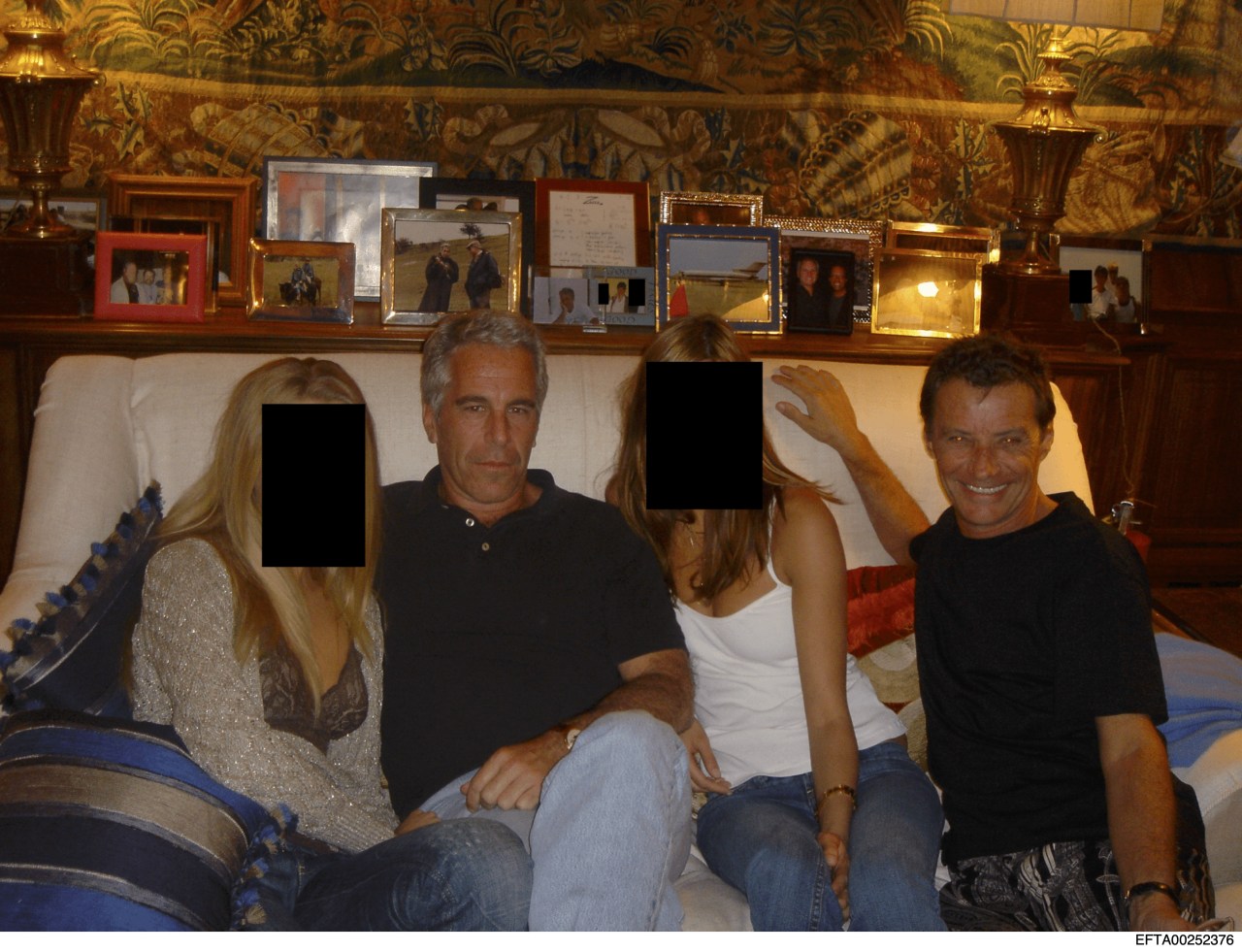
The rift between Epstein and Brunel was temporary, the recently released Justice Department files show. By April 2015, Brunel suggested a friend to mediate the dispute, and later that month Epstein asked to meet Brunel. “I have some ideas. that I think you will like,” Epstein wrote on April 14.
Still, over the following year, Pottinger, along with Boies and Edwards, corresponded with the federal prosecutors in New York and Titone to get Brunel to cooperate. By 2016, Brunel had agreed to turn himself in and was naming names.
The prosecutor’s notes from Feb. 29, 2016, revealed that the victims’ lawyers briefed the prosecutors. “Titone says his client has photographic evidence,” according to the notes. “Brunel doesn’t want to implicate himself.”
On May 3, Pottinger wrote in an email to a prosecutor: “Yesterday I spoke of Daniel Siad, whom Jean Luc Brunel describes as a ‘scout’ or recruiter of girls and/or women for J. Epstein.”
Titone said Epstein eventually called him to discuss Brunel’s suit and tried to build a rapport, bonding over their shared Brooklyn roots. “He was a real charmer,” Titone recalled. He said that Brunel eventually settled the suit with Epstein and said the terms were confidential.
After the effort to get Brunel to testify failed, Epstein continued luring victims. When Epstein was found dead in his jail cell in 2019, Brunel went into hiding. French authorities launched an investigation shortly after, searching his home and offices.
In December 2020, French police intercepted Brunel at a Paris airport as he attempted to board a flight to Senegal. He was taken into custody and charged with sex crimes. In February 2022, he was found hanged in his prison cell.
Write to Khadeeja Safdar at khadeeja.safdar@wsj.com and Caitlin Ostroff at caitlin.ostroff@wsj.com