

The tribal hospital in Sittilingi valley in Dharmapuri district
| Photo Credit:
N. Bashkaran
On a misty Monday morning in the Sittilingi valley, nestled snugly between the Kalvarayan and Sitheri hills in western Tamil Nadu, people trickled into a stone compound of single-level structures made of sundried bricks, Mangalore-tiled roofs, and arched windows.
The earthen structure, resembling a village retreat, is a tribal hospital providing secondary healthcare facilities in one of the remotest parts of Tamil Nadu, about 45 km from the block headquarters of Harur in Dharmapuri.
Among the visitors that day was Revathi. She had brought her mother from Navakollai, 20 km away, as she has been doing for the last 10 years, bypassing the primary health centre just 5 km from her village.
“I’ve never seen anything like this place anywhere. They take women’s problems seriously. The doctors take time to listen and explain, spending at least 15 to 20 minutes with a patient. Even in private hospitals, doctors don’t listen to our complaints,” she says.
Sometime in 1993, a young couple in their early 30s, both clinicians from Gandhigram, arrived in the tribal valley of Sittilingi with a dream: to be doctors in a place where they were needed, where no other doctors had gone until then.
This dream would take shape as a 35-bed tribal hospital and give birth to the Tribal Health Initiative (THI), a community health programme (CHP) that would overturn Sittilingi’s abysmal infant mortality numbers within a decade, and go on to radically redefine the scope of health beyond the clinical, extending it to the social and economic determinants of well-being over the three decades since.
Gynaecologist Lalitha Regi and anaesthetist Regi George chose Sittilingi because of its geographical isolation, which has limited access to care as in all tribal areas, and its appalling infant mortality rate (IMR) – 147 babies per 1,000 live births – at the time.
If the couple conceptualised a CHP, the level of morbidity and mortality called for a different kind of action.“There was so much morbidity that we needed to address that first,” says Dr. Lalitha. They took over a poramboke land, where locals helped put up a one-room mud-and-thatch structure. “For three years, deliveries and some surgeries took place under a 100-watt bulb, on a bench.”
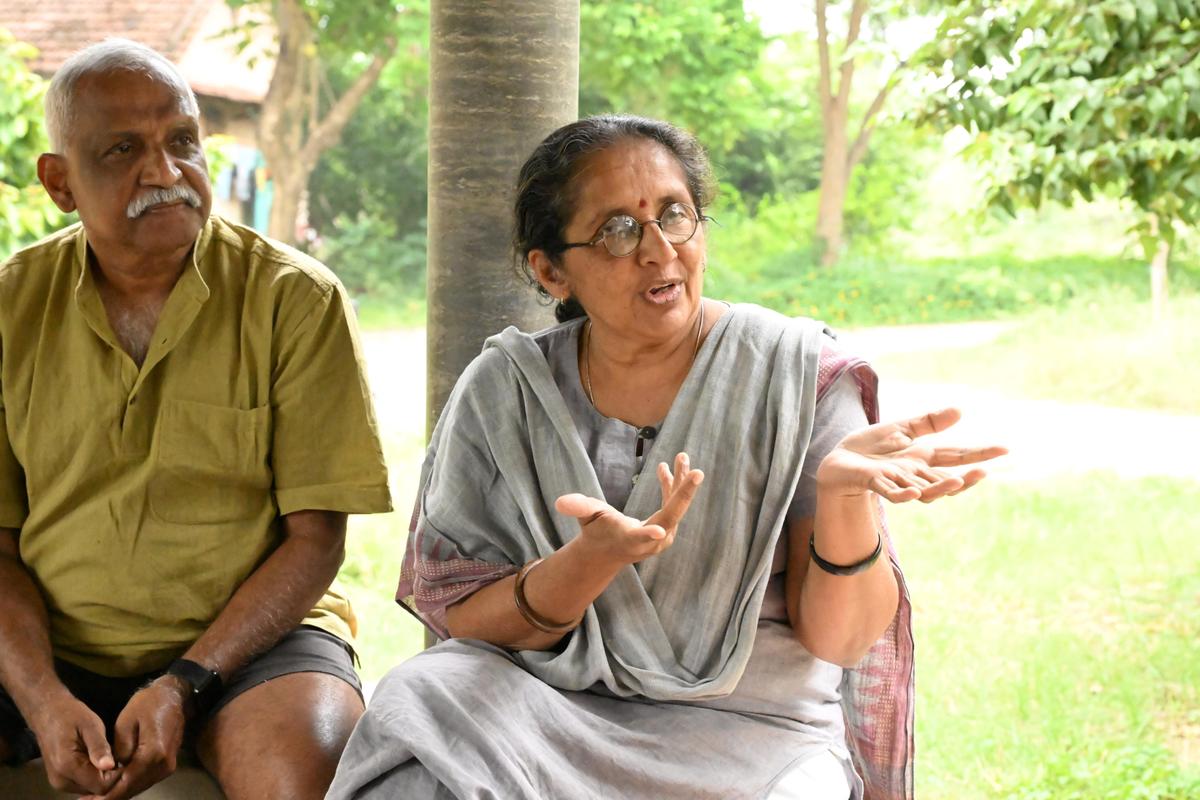
Dr. Regi George and Dr. Lalitha Regi, founders of the Tribal Health Initiative
| Photo Credit:
N. Bashkaran
Then came, through ActionAid, a 10-bed hospital and a centre to train locals to look after themselves. “The belief then, as it is now, was that any planning and resources had to come from here, not from outside,” adds Dr. Lalitha.
Early November this year, the McGill School of Population and Global Health named the Regis co-recipients of the prestigious Paul Farmer Award for Global Health Equity. The citation described their achievements as “countering the failures of imagination” and “having lived a life of accompaniment”.
Building from the ground up
The couple’s first health worker was a Class 8 passout Rajamma, who joined the hospital as a trainee in 1994. “We went to the villages asking for educated girls to help us at the hospital,” says Dr. Lalitha.
But the State’s all-pass-up-to-Class 8 curriculum, meant that young girls like Rajamma could read alphabets but not words or full Tamil sentences. Therefore, their training began with basic language and arithmetic before progressing to anatomy, physiology, pharmacology, diagnosis, and treatment.
“Diagnosis focused on the diseases prevalent in this area, nothing extra. What they would see, how they would diagnose and treat…” added Dr. Regi. “That’s why we called them health workers, because they were much more than nurses.” Similarly, they trained lab technicians and an accounts team. Much was improvised as there was no money. The hospital’s first autoclave was a pressure cooker. “We had to make do with what we had for all sorts of emergencies, because people couldn’t go anywhere,” adds Dr. Regi.
Health auxiliaries
“We were seeing people only when they came to the hospital. There was no one to see what was happening in the village. So, we asked each village to select one person free of child-rearing responsibilities.” Twenty-one villages had sent 25 women, who would become trained health auxiliaries, and go on to form the backbone of the community health programme.
The first goal was to tackle infant mortality. Since malnutrition, respiratory diseases, and diarrhoeal diseases accounted for a high proportion of under-five deaths in most places, health auxiliaries were trained to focus only on these, through nutrition management, malnutrition prevention, early detection and treatment of respiratory diseases, recognising symptoms of pneumonia, and safe delivery practices.
“In the villages, skilled mothers did home deliveries. The health auxiliaries would monitor home deliveries and bring them to the hospital in case of an emergency,” says Dr. Lalitha.
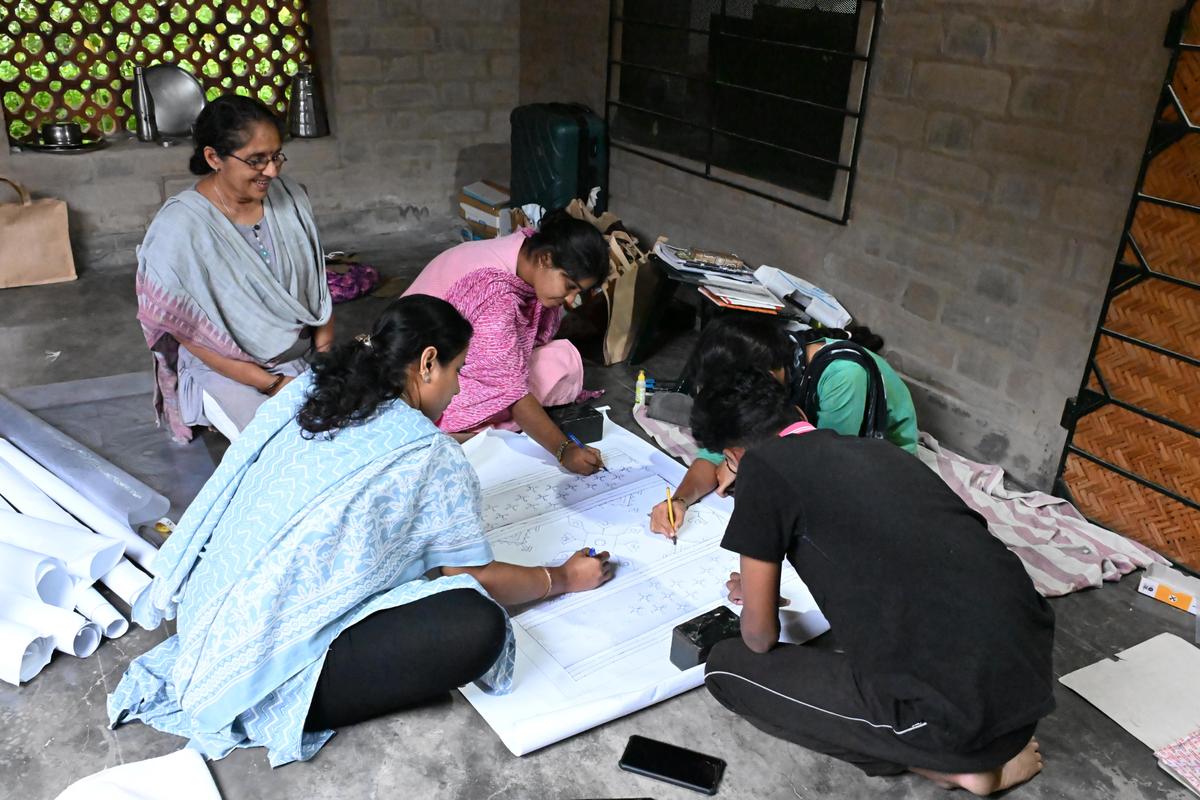
Women crafting garments in Sittilingi valley under the Tribal Health Initiative
| Photo Credit:
N. Bashkaran
By 2003, the IMR dropped to 60, and further declined to 20 by 2008, when even the Tamil Nadu average was 35 and the national average, 53. Today, Sittilingi’s IMR stands at 8.
Maadeshwari’s life changed after one such village meeting in 1998. She had completed only up to Class 8. When the hospital came up, she knew she wanted to do something there. “Seeing my teachers and Dr. Lalitha, I too wanted to be like them and achieve something in life.”
She wrote her SSLC examinations and joined the hospital as a health worker trainee. She was trained in deliveries, surgeries, out-patient and operation theatre. “Initially, one of us (trainee) would faint at the sight of blood. But, Dr. Lalitha and Dr. Regi trained us patiently, showing us each step – from the mother’s arrival to the delivery and beyond.”
Then came another big step.
Focus on farming
At the Sittilingi Organic Farmers Association (SOFA), one of the 700 organic farmers registered with the offshoot of the THI peers into a laptop camera. “This seeding of biometric data is for the certification of the organic produce from the particular farmer’s land,” says Manjunath, coordinator of SOFA and one of the earliest community members of the THI.
“In 2003, we carried out an external evaluation of the THI,” says Dr. Lalitha. “Among the observations was that if we want to achieve what we did with the IMR, there are other social, economic, and political determinants of health, like food, employment, and income [we should consider]. Unless you address the economy of the people, you cannot tell them what they should eat.”
“There were many complaints — schools not functioning, poor roads, transport, and water. But one consistent issue was that farming was at a loss, yet it was the only thing they knew,” explains Dr.Regi.
Farmers were initially resistant to organic farming, fearing losses. But after two years of talks, four farmers took it up, and soon, the initiative spread. SOFA was formed, which today represents 700 organic farmers in the Sittilingi Valley. Sittilingi’s organic produce, including millets, turmeric, pulses, and a variety of millet-based products such as biscuits and savouries, is now a regular feature in organic stores.
Reviving a lost art
In subsequent years, the THI’s focus on the local economy deepened. The Sittilingi panchayat also includes two Lambadi villages and one Dalit village. “I noticed that the rich craft of Lambadi embroidery had died because nobody wore that attire anymore,” Dr. Lalitha said.
A little probing led her to Neela and Gammi, two women in their seventies who had learnt the craft from their grandmothers. “They wore sarees, and their mothers wore sarees, but their grandmothers were the last to wear the Lambadi attire,” she said.
They remembered the art, and in 2006, 10 young people came forward to learn it. Tamil Nadu Lambadi embroidery was thus revived. Porgai (which means pride and dignity in the Lambadi language), an artisans’ association formed in 2009, has been registered as a Producers’ Company with 70 shareholders this year.
“It is an unfair market in India for crafts, and artisans don’t earn much. So we thought we’d do something different: create art that is viewed and valued differently. They organised an at-home artists’ residency for 10 artisans, where artists come to stay and learn for four months.”
This year, 20-year-old Sindhu graduated from NIFT, becoming the first graduate of design from Lambadi community. Similarly, women wanted sustained work, as agricultural opportunities were limited on marginal landholdings. Vanavil, a tailoring service society for brands, was born out of that demand.
The THI’s high notes came in 2019, when it radically pushed the boundaries of a CHP into local self-governance. Health worker Maadeshwari contested and won the Panchayat elections by a margin of 500 votes. Madagapaadi, a village of 50 houses located 55 km away, received a slew of firsts, including electricity, houses, water supply through over-head tanks, during her tenure. “At first, our friends thought we were crazy to do this. But Maadeshwari won and did great work,“ says Dr. Regi.
The Sittilingi Model
“We function as a secondary care hospital,” said Dr. Ravi, one of the earliest doctors to join the hospital after similar rural stints in Odisha. “In any population, out of 100 patients, 50 can be seen by a regular medical officer, another 30 will need a specialist, and the remaining 20 will require higher-level hospitals. A normal delivery should be managed by a good primary or secondary-level healthcare facility. That’s what we are trying to do. We are not trying to replace the government system, but to provide an alternative secondary care that may not be available.”
In 2018, a Rural Sensitisation Programme was started for 35 medical students and some doctors, who came to stay in Sittilingi for three days to see how a secondary care hospital in a tribal area could match what private hospitals in the city were doing, but in a much more economical and meaningful way.
“They go to the villages, see the villagers in their homes, witness their lives and problems, and understand their access to health. They come back and discuss, and return changed, questioning why this is not part of the medical curriculum,” says Dr. Regi.
But the doctors wanted more than just three days to make a life decision. So this year, travel fellowships for doctors were conceived. “We talked to organisations working in rural areas, slums, and tribal regions. The travelling doctors would visit these places for two to three months to see how these organisations are tackling problems. With changing geographies, diseases vary, and they see the real India. By the end of it, they are completely transformed,” says Dr. Regi.
Can the Sittilingi Model be replicated everywhere? “The State can, if it wants to,” says Dr. Lalitha. “It has the infrastructure. But success comes with community involvement. What is relevant for a tribal area like Sittilingi, with a homogenous tribal community, is not necessarily relevant even for a taluk like Harur. People are different, and their attitudes are different. First, you have to sit down and listen to people. All our programmes are run by the local people, which is what makes them successful.”
According to Dr. Regi, Sittilingi model, as we describe it now, was a series of spontaneous interventions that now makes sense, having elevated health to a certain level. “It is to show doctors that there is another way of tackling health. We have planted a seed; the seed should be taken and planted elsewhere too.”
At the heart of the conversations was a single underlying thread: respect. The patients wanted to be respected, and so did the community. Clearly, that is where meaningful and sustainable change begins.