
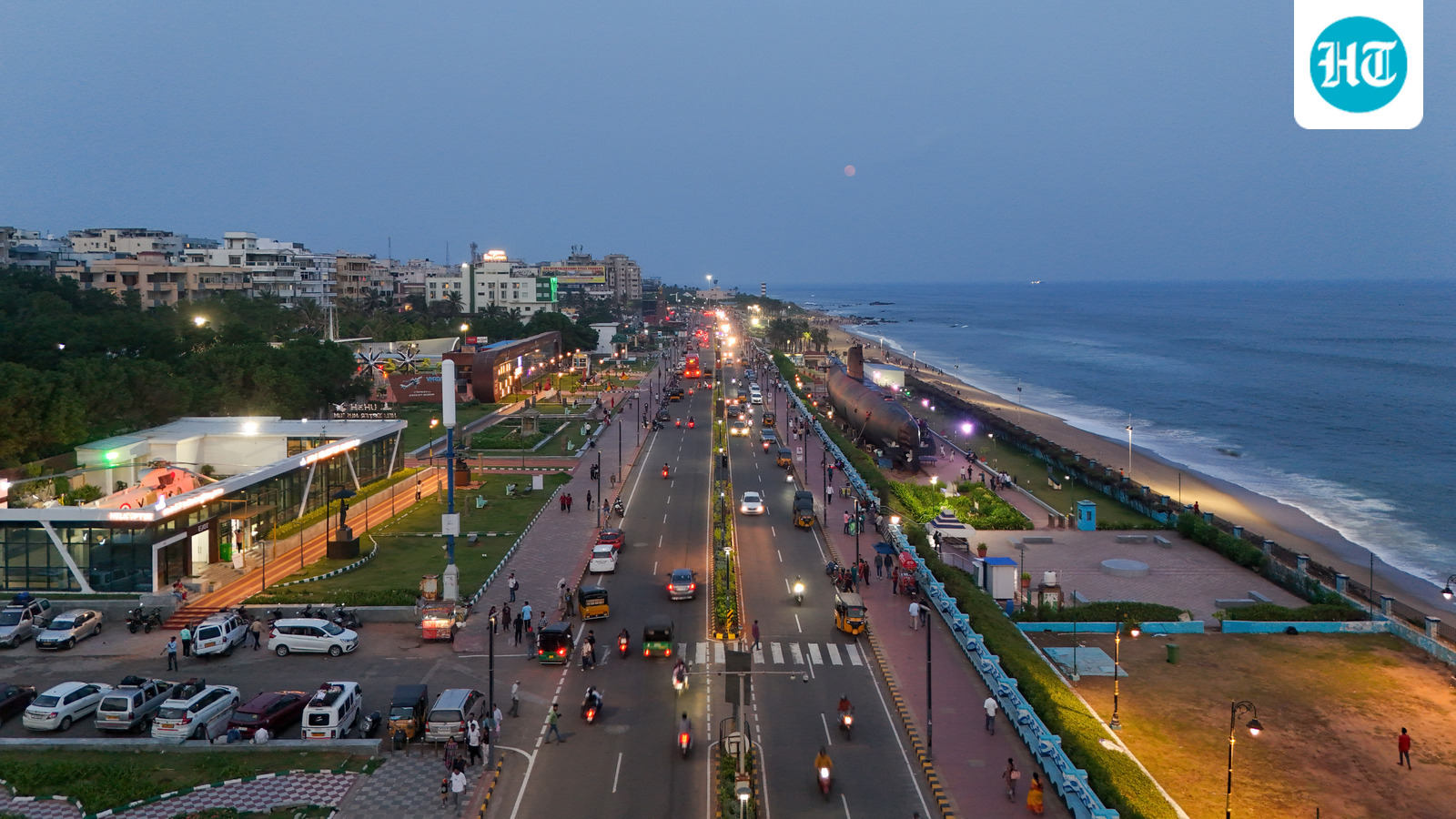
As the Sunday sun melts into the Bay of Bengal, Visakhapatnam’s RK Beach Road — the city’s social spine — springs to life. Queues spill out of the naval museums, with the INS Kursura submarine drawing the longest line. Tourists play on the sands, couples stroll along the broad, clean footpaths, and cafés buzz with chatter in Telugu, Hindi, English, and Bengali, giving Vizag — its fond nickname — the easy charm of a compact, multicultural city.

Seated on a bench, a group of fresh GITAM University engineering graduates share dreams over coffee. “I’ve landed a job in Hyderabad, but I’ll probably be back soon to live and work here in my own city. Every month, I hear of new companies planning to set up shop in Vizag,” says 21-year-old Sai Sashank Arya. Rajesh Goyal, an IT professional from Pune on a six-month stint in the city, nods in agreement. “This place has a real Californian vibe—the ocean, the hills, and the rising and falling, winding roads. This city has the potential to be the San Francisco of India. I plan to buy a home here,” he says.
Long known for shipyards, its formidable steel plant, and its many public sector giants, this quiet port city has been refashioning itself as India’s next big tech destination. It recently hit the headlines after Google’s blockbuster announcement: a $15-billion plan for its first and largest Artificial Intelligence (AI) hub outside the US.
Earlier this year, LinkedIn named Vizag the fastest-growing non metro in its Cities on the Rise 2025 report, cementing the city’s reputation as a magnet for tech talent and professionals seeking a calmer alternative to the frenetic buzz of Bengaluru or Pune. Earlier this month, the Confederation of Indian Industry (CII) Partnership Summit in the city saw Andhra Pradesh secure ₹13.25 lakh crore in investment pledges, with a significant share flowing into Vizag, including Reliance’s announcement of a 1 GW AI data centre.
In this city of 2.5 million — the third-largest on India’s east coast — the air is thick with possibility.
The Bay City vision
Goyal’s comparison of Vizag with San Francisco isn’t mere idle talk — at least not when it comes to the city’s beautiful natural backdrop. Here, hills meet the sea along nearly 40 unbroken kilometres of coastline, while the Eastern Ghats rise up sharply on the other. The Andhra Pradesh government is aware of this asset, and is setting its sights high: two flagship urban extensions are in the works. There’s Vizag 2.0, a vast 210 sqkm addition, and the evocatively named Vizag Bay City — a 40 sqkm brownfield project that seems to borrow both inspiration and branding from California’s Bay Area.
“Vizag Bay City will stretch along a part of the city’s coastline as a premier MICE [Meetings, Incentives, Conventions and Exhibitions] destination — with hotels, convention centres and leisure spaces,” says district collector MN Harendhira Prasad, seated in his stately office in the 1913-built Visakhapatnam Collectorate, a red-brick building in the Indo-Gothic style. “Our goal is to make the city east India’s top address for large-scale business and leisure events.”
For decades, Vizag’s economic heart lay in the industrial sprawl of Gajuwaka to the west — a dusty, dense cluster of factories, warehouses and migrant settlements powering the port, steel, and petroleum supply chains. But lately, the action has decisively drifted north to the hills where tech parks are now redrawing the city’s economic map.
Rushikonda and Madhurawada — once sleepy suburbs — are today dotted with glass-fronted IT campuses perched on scenic heights. Four hills, known simply by their numbers, anchor the city’s “hill-tech” revolution. Hill No. 1 hosts Fluentgrid and Miracle Software Systems; Hill No. 2 houses Infosys, Maple Software, and Symbiosys Technologies. Hill No. 3, a 200-acre IT SEZ, features Xenott, TCS (recently operational), and the ₹1,500-crore AI-powered edge data centre and cable landing station being built by Sify Infinit Spaces.

This shift to the hills isn’t accidental. Ready availability of land and a deliberate government push for a “hill-tech” identity have made these slopes the newest frontier for IT development in Vizag. “We’ve built an integrated tech ecosystem with custom incentives,” says Keerthana Anand Pasupuleti, a manager at the Andhra Pradesh Economic Development Board, who oversees IT investments in the city. “More than 20 major companies are already here, with many more in the pipeline. Nearly 15,000 people now work on these hills.”
From her glass-walled office at the Sunrise IT Incubation Centre on Hill No. 3, one gets a panoramic view of IT campuses rising in the hills.
Vizag’s tech boom isn’t just about marquee names or big-ticket announcements. “The city now has around 200 small and mid-sized IT firms and BPOs employing over 45,000 people, a number set to rise sharply in the coming months,” says Murali Krishna Gannamani, founder of Fluentgrid and chairman of CII Andhra Pradesh. But, what draws companies here?
“It’s simple. Vizag is peaceful, safe for women, and has an English-speaking talent pool, helped in part by the city’s strong Navy presence. Many of my clients who visit our hillside campus are immediately struck by its beauty,” he says.
But, Vizag’s growth story goes beyond IT. The city is becoming a medical technology hub as well. On the outskirts, near the steel plant, the 270-acre Andhra Pradesh MedTech Zone (AMTZ), India’s largest, buzzes with about 150 companies, each housed in state-of-the-art spaces equipped for biomaterials research, 3D printing, laser engineering, and advanced magnet development. Eighty of these firms arrived in just the past two years.
The AMTZ campus also hosts the Erba Global MedTech University, set amid expansive greens and offering programs ranging from MTech degrees in medical devices and bioengineering to an MBA in regulatory affairs and entrepreneurship, along with PhD opportunities in medical technology.
Closer to the city, the 350-acre Health City in Arilova has emerged as a major medical hub, home to nearly 40 hospitals of all sizes, including Apollo and Narayana Medicity.
Together, these clusters have reshaped Vizag into a multisector innovation node — much more than just an emerging IT story.
A new spirit of entrepreneurship
Entrepreneurs have sensed this shift. When EK Niyas co-founded Orange Business Centre, Vizag’s first co-working space in 2019, he was discouraged — people told him the city was “just a big village”. But, all 30 seats were filled quickly. He now runs four such spaces.
“Demand has surged in the past year, with many professionals from Bengaluru, Hyderabad, and even Gurgaon showing interest. The state government’s policies have boosted the ecosystem,” he says, seated in his flagship branch in a leafy neighbourhood just off Beach Road, now home to nearly 60 startups across IT, education, and biosciences.
“The city is now home to over 1,200 startups, and half of those have come up in the last year-and-a-half,” says Ravi Eswarapu, CEO, Ratan Tata Innovation Hub (RTIH), Visakhapatnam, a government-led incubator network with five hubs statewide. He credits new state policies, which offer investment funds, cutting-edge lab spaces, and direct market access, for sparking this surge.
This new enabling climate has inspired a whole new cafe culture. On a breezy Saturday afternoon, Bean Board, the city’s most popular cafe perched over the scenic Rushikonda, is often packed — not just with students, but now with young IT professionals and startup founders, laptops open, conversation flowing. “These days, business plans are being spun at every table,” laughs Y Isaac Jeremiah, the roaster behind Vizag’s cafe revolution. With eight outlets already operational, Jeremiah is now set to open four more, alongside AI-powered robotic cafés launching soon at the city’s tech parks and airport.
Bold infrastructure leap
Visakhapatnam’s transformation is matched by a rapid surge in infrastructure development. The ₹5,400-crore Bhogapuram International Airport, just 45km north of the city, is nearing completion. It is over 90% done and slated to open by mid-2026. Meanwhile, the 77-km Vizag Metro project’s first phase, stretching from Madhurawada to Gajuwaka via Rushikonda, is under construction.
The Visakhapatnam Metropolitan Region Development Authority (VMRDA), the city’s urban planning and development authority, is executing several civic and tourism projects simultaneously. “We are building seven master roads to connect with the new airport, and the government has asked us to rework the Master Plan 2041 to reflect the city’s new growth dynamics,” says K Ramesh, joint commissioner, VMRDA.
District collector Prasad adds: “We’re also upgrading 15 key roads and constructing a 20-km double-decker corridor –– India’s longest –– with traffic below and metro lines above, creating a new urban transit experience.”
Among the city’s upcoming landmarks is a 55-metre cantilever glass skywalk on Kailasagiri Hill, which has a massive illuminated “Kailasagiri” sign perched above the city, styled after the famous Hollywood letters in Los Angeles.
Cleanliness is a constant priority in the city. Vizag consistently ranks among the top ten performers in the Swachh Survekshan cleanliness surveys, and its streets demonstrate why. “We are currently beautifying 26 major roads and conducting Operation Lungs, an anti-encroachment campaign reclaiming public spaces to ease traffic and enhance walkability,” says Ketan Garg, commissioner, the Greater Visakhapatnam Municipal Corporation (GVMC).
RK Beach Road stands as a great example of the “streets for people” ethos, with broad footpaths, designated parkings, benches, gardens, sculptures, open-air gyms, and a dedicated pedestrian-only morning window welcoming thousands of walkers.
Global institutions back these efforts. The International Finance Corporation (IFC) has pledged over $60 million to GVMC. “ It is the first time it has funded an Indian city government without sovereign guarantees,” Garg says. These funds are fuelling an underground sewerage project in Madhurawada. Also, Vizag is among 50 global finalists in the Bloomberg Philanthropies Mayors Challenge 2025, recognised for its climate-resilient and inclusive V-PULL living-lab initiative, highlighting the city’s forward-thinking urban governance.
The real estate boom
This momentum has sparked a property boom. Giant billboards now dot the cityscape, advertising luxurious bayfront villas and hilltop apartments. Property prices first surged in 2019, spurred by the previous YSR Congress Party government’s proposal to designate Vizag as the executive capital — a move that triggered 25–50% jumps in hotspots like Madhurawada and Rushikonda. The market cooled briefly following the 2024 reinstatement of Amaravati as the sole capital by the current Telugu Desam Party (TDP)-led government, but the latter’s aggressive push in IT, infrastructure, and tourism has reignited demand.
Not just major developers from Hyderabad, including My Home, Lansum, and Ramky, but also big players from outside such as Raheja and Sattva have rolled out ambitious projects. The Yendada locality is particularly sought after, with 2-BHK apartments priced at ₹65–80 lakh and 3-BHKs reaching ₹1.3 crore — a 30% rise over the past three years. “Yendada can become Vizag’s Hi-Tech City. Google’s data centre announcement has truly revitalised the property market in the city,” says V Dharmender Varada, a US-returned chartered accountant- turned- developer and chairman of the Confederation of Real Estate Developers’ Associations of India (CREDAI), Visakhapatnam.

At Lansum Oxygen Towers — the city’s tallest building at 35 storeys, 3-BHK apartments now range from ₹2.3 to ₹3 crore, having quadrupled in price over just six years. “Vizag’s property market is maturing steadily. It will take about five more years before the city sees Hyderabad-style skyscrapers. Major investments in road infrastructure are still needed, but momentum is unmistakable,” says K Umesh, chairman, Lansum Properties and an IRS officer- turned- developer. His firm is developing luxury villas worth over ₹3 crore in Vizag, about 8km from the upcoming Google data centre in Tarluvada, and “the project is already sold out,” he adds.
A blend of Goa-Bengaluru
Not just tech — tourism too is getting a thrust. Vizag has three major beaches — RK Beach, Rushikonda, and Yarada — and a long 40-km scenic coastal drive, perhaps India’s longest urban coastal stretch. Rushikonda also has a certified Blue Flag beach.
The state’s new Tourism Policy 2024–29 identifies Vizag as an anchor hub, attracting hotel chains like Oberoi and Mayfair. Besides, the Varun Hospitality Group is developing Barun Bay Sand, a mixed-use luxury project in partnership with Indian Hotels Company (IHCL) inspired by Singapore’s Marina Bay Sands on Beach Road.
“We are promoting Vizag as a prime destination for conferences and weddings. The government envisions the city as a blend of Bengaluru’s dynamism and Goa’s charm,” says PGS Kalyani, regional director of tourism in Vizag.
“While the government is working to increase the number of star hotel rooms, there’s a need to market Vizag more aggressively, especially in northern India, where many are still unaware of the city’s natural beauty and attractions,” adds MV Pavan Kartheek, a Vizag-based hotelier and president of the Hotels and Restaurants Association of Andhra Pradesh.
The city’s many attractions include Navy-driven public events, which infuses a maritime spirit in Vizag’s civic life. The Eastern Naval Command — the largest service command in India by area — has its headquarters here, and its presence is palpable. From marathons and school outreach initiatives to mesmerising Operational Demonstrations on RK Beach that attract lakhs of spectators, the Navy is woven into the city’s identity. The naval museum corridor on the Beach Road — featuring the INS Kursura Submarine Museum, TU-142 Aircraft Museum, Sea Harrier Museum, and the new UH-3H Helicopter Museum —is a constant reminder of this lasting connection.

Apart from the annual Navy Day celebrations on December 4, Vizag will host three major international maritime events between February 15 and 25, 2026 — the International Fleet Review, Exercise MILAN, and the Indian Ocean Naval Symposium (IONS) Conclave of Chiefs. During crises such as cyclones, the Navy’s Humanitarian Assistance and Disaster Relief (HADR) teams are often the first responders.
“There are approximately 40,000 families in Vizag who form the city’s large naval fraternity,” says Commander Sujit Reddy, Defence PRO for Andhra Pradesh, based at the Eastern Naval Command in Visakhapatnam. “The civil–military coordination here is unlike any other Indian city, with a designated Civil–Military Liaison Officer acting as a crucial bridge between the Navy and state and city administrations for day-to-day coordination,” he adds.
Worries amid boom
Most residents describe Vizag as a “safe city”, shaped partly by relatively moderate crime rates and partly by a responsive police culture. In fact, Kohima, Visakhapatnam, and Bhubaneswar, emerged as the safest cities in the country for women, according to the National Annual Report & Index on Women’s Safety (NARI) 2025.
Police commissioner Shanka Brata Bagchi, popular for sharing his personal mobile publicly, says the force is preparing for a larger, more spread-out city.
“We are expanding strength, modernising, and adopting new technologies,” says Bagchi, responding to non-stop calls during the conversation. “Answering every call has helped prevent several suicides and even trafficking cases. Cybercrime and drug offences are our biggest priorities right now.”
Yet, amid this excitement, there is apprehension. KSR Murthy, 77, associate president of the AP Federation of Resident Welfare Associations, who has called Vizag home for 46 years, fears the city’s peaceful charm could soon give way to congestion, spiralling prices, and the chaos that plagues Bengaluru and Pune.
“This has long been a city of service-class people, and many now worry about the rising cost of living. Real estate prices are climbing. Traffic could become a serious concern because there’s no scope for a ring road — there’s the sea on one side and hills on the other,” he says, sitting in his JR Nagar apartment RWA office. “RWAs here are deeply engaged with civic issues — from plastic waste and encroached footpaths to pollution control and the need to stop drains discharging untreated waste into the sea,” he says. “We just hope that as Vizag grows, it retains its natural beauty and calm.”