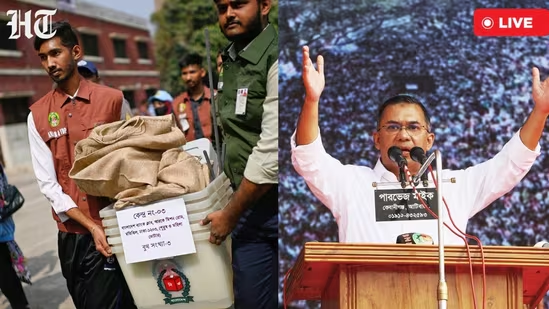

Bangladesh election 2026 live updates: Tarique Rahman, the son of former prime minister Khaleda Zia, who died in December, is BNP’s main face in the race.
Bangladesh election 2026 live updates: Bangladeshis are voting today in a key general election, the first after a mass movement brought an end to the 15-year tenure of former prime minister Sheikh Hasina. The poll is also being seen as the country’s first real contest since 2009, despite Hasina’s Awami League being stopped from contesting after the Election Commission cancelled its registration.
More than 127 million people are eligible to vote in the country of nearly 170 million. A total of 1,981 candidates are in the fray for seats in Parliament across the nation. The process is being managed by an interim government headed by Nobel Peace Prize winner Muhammad Yunus, which has promised free, fair and peaceful elections.
Who are the top contenders?
For years, politics in Bangladesh has centred on two rival families and two powerful women, Sheikh Hasina and Khaleda Zia.
Sheikh Hasina led the country for much of this period, but her Awami League has been barred from contesting the current election. After the ban, the Bangladesh Nationalist Party (BNP) emerged as the front-runner. It has put forward Tarique Rahman, the son of former prime minister Zia, who died in December, as its main face in the race.
Rahman came back to Bangladesh in December after spending 17 years in self-imposed exile. He has said he wants to strengthen democratic institutions, revive the rule of law and revive the economy.
The BNP is facing a challenge from an 11-party bloc led by the Islamist Jamaat-e-Islami, which seeks to expand its role in national politics. Notably, Jamaat-e-Islami was banned during Hasina’s tenure, but it has since regained ground after she was removed from office. This coalition also includes the recently launched National Citizen Party, formed by Gen Z student leaders linked to the 2024 uprising.
World’s first Gen Z-inspired election
Many of the young people who played a part in removing her government in the 2024 uprising believe this election will be the Muslim-majority nation’s first real contest since 2009, the year Hasina began her 15-year tenure.
The National Citizen Party, led by Gen Z activists under 30, has joined hands with Jamaat after it failed to turn its anti-Hasina street protests into broader voter support.
“Several factors will shape the outcome, including how Generation Z, which makes up about a quarter of the electorate, votes, as their choices will carry considerable weight,” Parvez Karim Abbasi, executive director at Dhaka’s Centre for Governance Studies, told news agency AFP.
What did Sheikh Hasina say about the elections?
Bangladesh’s ousted prime minister Sheikh Hasina criticised the vote from her exile in India after her party was prevented from contesting.
In an email sent to The Associated Press earlier this month, Hasina warned that Bangladesh could face long-term instability if the election is not inclusive, free and fair.
“Each time political participation is denied to a significant portion of the population, it deepens resentment, delegitimises institutions and creates the conditions for future instability,” she wrote.
“A government born of exclusion cannot unite a divided nation,” Hasina added.
Key issues as Bangladesh heads to polls
These are the main concerns in the country, which has been run by an unelected interim administration since Hasina’s turbulent removal from power:
Corruption: A recent survey by the Dhaka-based Communication Research Foundation and Bangladesh Elections and Public Opinion Studies showed that corruption is the biggest worry for voters. Bangladesh has for years ranked among the worst performers in Transparency International’s Corruption Perceptions Index.
Inflation: Official figures show inflation rose to 8.58% in January. In the same survey, more than two-thirds of those questioned named “prices” as their second-most serious concern.
Economic development: Bangladesh was once among the fastest-growing economies in Asia. However, the nation has found it hard to recover pace after the COVID-19 pandemic disrupted its export-led garment industry. People placed economic development as their third main concern.
Employment: About 40% of the population is under 30. The next government will face strong pressure to create jobs for millions of young citizens following months of unrest.
Ban on Awami League: Hasina’s Awami League has been kept out of the election. She said that without her party, millions of its backers will have no one to vote for, and many could choose to boycott the polls. Some citizens have said they will not vote. However, experts do not expect a large-scale boycott and believe former Awami League supporters will still influence the final result.
A crucial test for Bangladesh’s democracy
Apart from the vote, there will be a referendum on political reforms. These proposals include limits on the length of a prime minister’s term, tighter checks on executive authority, and other steps to curb the concentration of power in Parliament.
The outcome will show whether the country moves towards real institutional change or continues under existing power patterns. Since gaining independence from Pakistan in 1971, Bangladesh has seen periods of military rule and fragile democratic systems.
The result will also indicate whether youth-led protest movements can turn into lasting democratic change. Nearly 5 million people are first-time voters and will cast their ballots for the first time.
…Read More
More than 127 million people are eligible to vote in the country of nearly 170 million. A total of 1,981 candidates are in the fray for seats in Parliament across the nation. The process is being managed by an interim government headed by Nobel Peace Prize winner Muhammad Yunus, which has promised free, fair and peaceful elections.
Who are the top contenders?
For years, politics in Bangladesh has centred on two rival families and two powerful women, Sheikh Hasina and Khaleda Zia.
Sheikh Hasina led the country for much of this period, but her Awami League has been barred from contesting the current election. After the ban, the Bangladesh Nationalist Party (BNP) emerged as the front-runner. It has put forward Tarique Rahman, the son of former prime minister Zia, who died in December, as its main face in the race.
Rahman came back to Bangladesh in December after spending 17 years in self-imposed exile. He has said he wants to strengthen democratic institutions, revive the rule of law and revive the economy.
The BNP is facing a challenge from an 11-party bloc led by the Islamist Jamaat-e-Islami, which seeks to expand its role in national politics. Notably, Jamaat-e-Islami was banned during Hasina’s tenure, but it has since regained ground after she was removed from office. This coalition also includes the recently launched National Citizen Party, formed by Gen Z student leaders linked to the 2024 uprising.
World’s first Gen Z-inspired election
Many of the young people who played a part in removing her government in the 2024 uprising believe this election will be the Muslim-majority nation’s first real contest since 2009, the year Hasina began her 15-year tenure.
The National Citizen Party, led by Gen Z activists under 30, has joined hands with Jamaat after it failed to turn its anti-Hasina street protests into broader voter support.
“Several factors will shape the outcome, including how Generation Z, which makes up about a quarter of the electorate, votes, as their choices will carry considerable weight,” Parvez Karim Abbasi, executive director at Dhaka’s Centre for Governance Studies, told news agency AFP.
What did Sheikh Hasina say about the elections?
Bangladesh’s ousted prime minister Sheikh Hasina criticised the vote from her exile in India after her party was prevented from contesting.
In an email sent to The Associated Press earlier this month, Hasina warned that Bangladesh could face long-term instability if the election is not inclusive, free and fair.
“Each time political participation is denied to a significant portion of the population, it deepens resentment, delegitimises institutions and creates the conditions for future instability,” she wrote.
“A government born of exclusion cannot unite a divided nation,” Hasina added.
Key issues as Bangladesh heads to polls
These are the main concerns in the country, which has been run by an unelected interim administration since Hasina’s turbulent removal from power:
Corruption: A recent survey by the Dhaka-based Communication Research Foundation and Bangladesh Elections and Public Opinion Studies showed that corruption is the biggest worry for voters. Bangladesh has for years ranked among the worst performers in Transparency International’s Corruption Perceptions Index.
Inflation: Official figures show inflation rose to 8.58% in January. In the same survey, more than two-thirds of those questioned named “prices” as their second-most serious concern.
Economic development: Bangladesh was once among the fastest-growing economies in Asia. However, the nation has found it hard to recover pace after the COVID-19 pandemic disrupted its export-led garment industry. People placed economic development as their third main concern.
Employment: About 40% of the population is under 30. The next government will face strong pressure to create jobs for millions of young citizens following months of unrest.
Ban on Awami League: Hasina’s Awami League has been kept out of the election. She said that without her party, millions of its backers will have no one to vote for, and many could choose to boycott the polls. Some citizens have said they will not vote. However, experts do not expect a large-scale boycott and believe former Awami League supporters will still influence the final result.
A crucial test for Bangladesh’s democracy
Apart from the vote, there will be a referendum on political reforms. These proposals include limits on the length of a prime minister’s term, tighter checks on executive authority, and other steps to curb the concentration of power in Parliament.
The outcome will show whether the country moves towards real institutional change or continues under existing power patterns. Since gaining independence from Pakistan in 1971, Bangladesh has seen periods of military rule and fragile democratic systems.
The result will also indicate whether youth-led protest movements can turn into lasting democratic change. Nearly 5 million people are first-time voters and will cast their ballots for the first time.
Follow all the updates here:
Feb 12, 2026 6:00:31 AM IST
Bangladesh election 2026 live updates: When will voting begin?
Bangladesh election 2026 live updates: Voting will start at 7:30 am (07:00 IST) today and end at 4:30 pm (16:00 IST).
Ballots will be cast at 42,761 polling centres spread across 64 districts, covering 300 parliamentary constituencies, according to the Election Commission of Bangladesh (ECB).
Feb 12, 2026 5:54:02 AM IST
Bangladesh election 2026 live updates: Sheikh Hasina’s party barred from contesting polls
Bangladesh election 2026 live updates: Sheikh Hasina’s Awami League has been prevented from contesting after the Election Commission suspended its registration.
The interim cabinet, led by Nobel laureate Muhammad Yunus, moved to ban the Awami League under the Anti-Terrorism Act. Bangladesh’s law affairs adviser Asif Nazrul announced the decision in May 2025.
Feb 12, 2026 5:39:09 AM IST
Bangladesh election 2026 live updates: Crucial vote today; BNP’s Rahman seen frontrunner
Bangladesh election 2026 live updates: Bangladesh will hold its crucial parliamentary elections today, nearly 18 months after a student-led movement removed then prime minister Sheikh Hasina from office. Her government, led by the Awami League, fell, and an interim administration took over under chief adviser Muhammad Yunus.
BNP leader Tarique Rahman, son of former prime minister Khaleda Zia, is seen as a strong contender in what is considered one of the country’s most important elections. He could become prime minister and lead Bangladesh, as his parents once did.